
Why Getting Your Standing Seam Ridge Cap Right Matters
A standing seam ridge cap is the metal trim piece that runs along the peak of a standing seam metal roof, sealing the gap where two roof slopes meet. It is one of the most critical components for keeping water, wind, and debris out of your home. As a premier Ohio roofing contractor, we specialize in high-performance metal systems that protect your investment for decades. According to the Metal Construction Association, proper trim installation is essential for the structural integrity of any metal roof.
Here is what you need to know at a glance:
| Key Topic | Quick Answer |
|---|---|
| What it does | Seals the roof ridge, prevents water infiltration, and gives a finished look |
| Main types | Fixed vs. floating; vented vs. unvented |
| Common materials | 24-gauge and 26-gauge steel, 29-gauge metal, Galvalume substrate |
| Minimum roof pitch | 3/12 pitch or greater |
| Key fasteners | #10×1″ pancake screws, pop rivets, double-sided butyl tape |
| Z-closure ratio | 20 linear feet of Z-closure per every 10 feet of ridge cap |
Getting this detail wrong leads to leaks, rust, and costly repairs — especially in Ohio where heavy snow, ice, and wind put roofs under serious stress year-round.
This guide walks you through the entire installation process, from choosing the right materials to finishing gable ends cleanly. Whether you are a hands-on homeowner or a contractor looking to sharpen your technique, you will find everything you need here.
I’m Albert Wengerd, owner of Mid Ohio Roofing, and I’ve installed and inspected standing seam ridge caps across dozens of residential and commercial metal roofing projects throughout Ohio. That field experience is what shapes every recommendation in this guide on standing seam ridge cap installation. If your ridge cap project has turned into a bigger job than expected — or the panels underneath are showing their age — our team handles metal roof repair and replacement across Central Ohio and can tell you honestly whether the rest of the roof is worth building on.
Understanding the Standing Seam Ridge Cap and Its Function
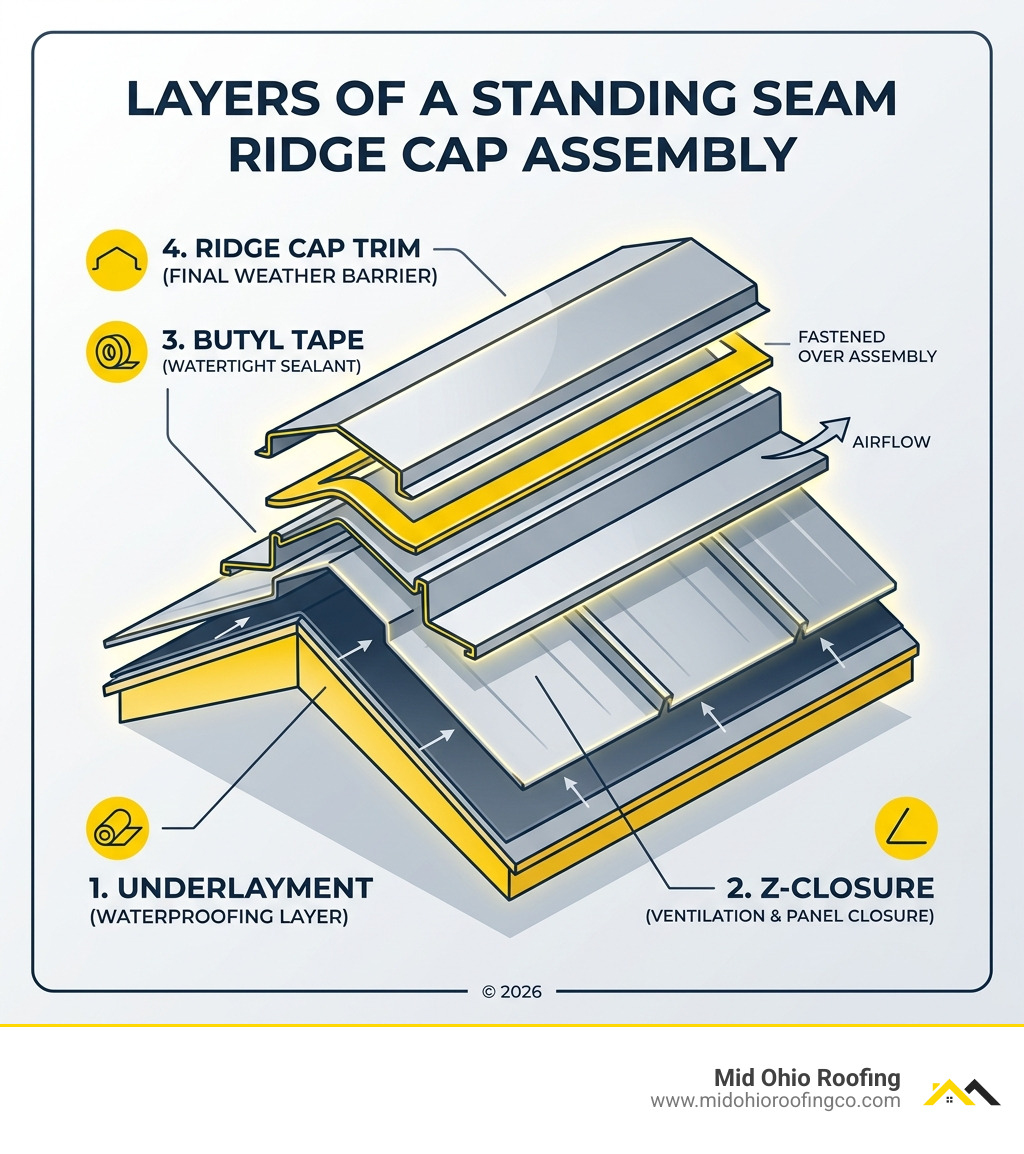
The primary function of a standing seam ridge cap is weatherproofing. Because the metal panels of a standing seam roof do not overlap at the very peak, a gap remains. The ridge cap bridges this gap, acting as the ultimate umbrella for your home. Beyond just keeping rain out, it must manage thermal expansion—the natural growing and shrinking of metal as temperatures fluctuate in places like Columbus or Newark, OH. The Metal Roofing Alliance notes that metal panels can expand significantly, requiring a ridge system that allows for movement without compromising the seal.
When we perform metal roofing services, we emphasize that the ridge cap is not just a “lid.” It is a dynamic component that works with Z-closures and sealants to create a watertight system. Without a properly integrated Ridge Cap For Western Lock® Standing Seam, wind-driven rain can be forced under the metal, leading to deck rot and interior damage.
Fixed vs. Floating Ridge Cap Mechanics
Choosing between a fixed or floating system is one of the most important technical decisions you’ll make.
- Fixed Ridge Cap: This is the most common residential detail. In this setup, the standing seam panels are “pinned” or fastened securely at the ridge. Because the metal needs to expand, a “floating” connection must be used at the eaves (the bottom of the roof).
- Floating Ridge Cap: Conversely, a floating ridge cap allows the panels to move freely at the top. This means the panels are pinned at the eave. This is less common in standard residential work but is vital for very long panel runs where thermal movement is extreme.
| Feature | Fixed Ridge Cap | Floating Ridge Cap |
|---|---|---|
| Panel Attachment | Pinned at the ridge | Pinned at the eave |
| Movement | Panels expand toward the eave | Panels expand toward the ridge |
| Commonality | Standard for most homes | Used for long industrial spans |
| Required Components | Z-closures | Z-closures + Panel End Supports |
Vented vs. Unvented Standing Seam Ridge Cap Systems
Proper ventilation is the lungs of your home. A vented ridge cap allows hot, moist air to escape the attic, preventing ice dams in the winter and reducing cooling costs in the summer. This is achieved by using perforated Z-closures or specialized venting material like Cor-A-Vent under the cap.
An unvented (or closed) ridge is typically used when the attic space is already conditioned or when other ventilation methods (like gable vents) are sufficient. When installing a vented ridge detail, we ensure the perforated strips are protected from “siphoning”—where water is sucked into the vent during a storm—by using high-quality butyl tape and specific layering techniques.
Essential Materials and Tools for Installation
Before you climb the ladder, you need the right kit. Accuracy is everything in standing seam work. Unlike asphalt shingles, you can’t easily “hide” a mistake in metal.
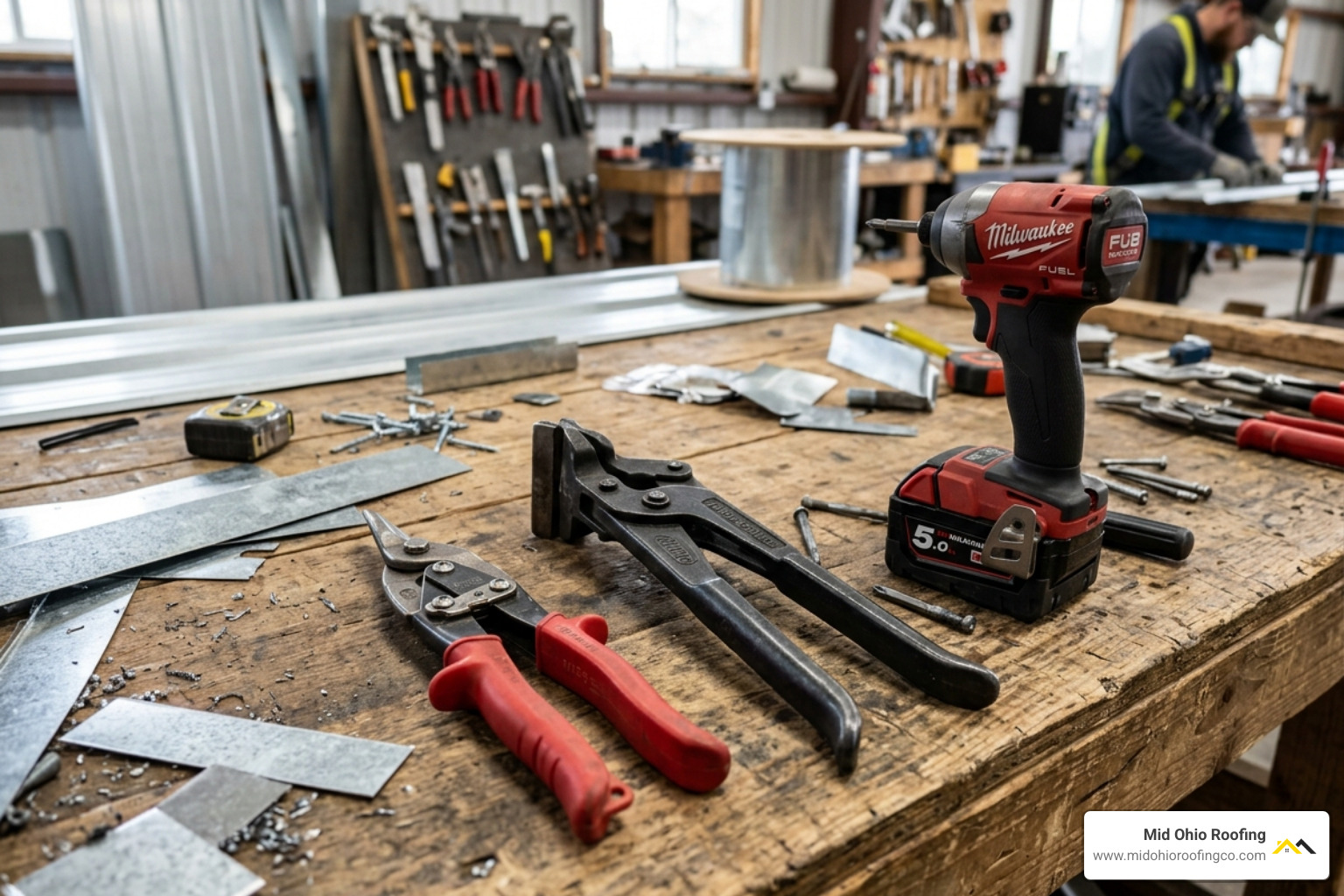
For a professional roof installation, ensure you have the following:
- Aviation Shears: For precision cutting of the ridge cap and Z-closures. High-quality tools from manufacturers like Malco Tools are essential for clean, professional edges.
- Hand Seamers: To bend the “hems” or edges of the metal.
- Drill/Driver: Preferably with a torque setting to avoid over-tightening screws.
- Pop Rivet Tool: Essential for joining the ridge cap pieces at overlaps.
Choosing the Right Standing Seam Ridge Cap Materials
Durability starts with the gauge (thickness) of the metal. ASTM International standards dictate the performance requirements for these materials.
- 24-Gauge Steel: The gold standard for standing seam. It is stiff, resists oil-canning (wavy appearance), and handles heavy Ohio snow loads.
- 26-Gauge Steel: A very common residential choice that offers a great balance of cost and strength.
- 29-Gauge Metal: Often used for agricultural buildings or MasterRib® Ridge Cap applications.
- Galvalume Substrate: Most modern ridge caps use a Galvalume coating (zinc and aluminum) for superior corrosion resistance compared to traditional galvanized steel.
Fasteners and Sealants for a Watertight Seal
The ridge cap is only as good as what holds it down. You cannot use standard wood screws here.
- #10×1″ Pancake Head Screws: These have a flat head that sits flush, allowing the ridge cap to slide over them without catching.
- Double-Sided Butyl Tape: This is non-negotiable. It creates a gasket-like seal between the Z-closure and the roof panel.
- Silicone and Butyl Tube Sealant: Used for “tooling” the corners and ensuring no water can creep into the gaps at the gable ends.
- Stainless Steel Pop Rivets: Used to secure the ridge cap to the Z-closure or to join two pieces of ridge cap together.
Step-by-Step Guide to Installing a Standing Seam Ridge Cap
Proper installation follows a specific sequence. If you miss a layer of sealant or a fastener early on, you may have to tear the whole ridge apart to fix a leak later.
Preparing the Panels and Z-Closures
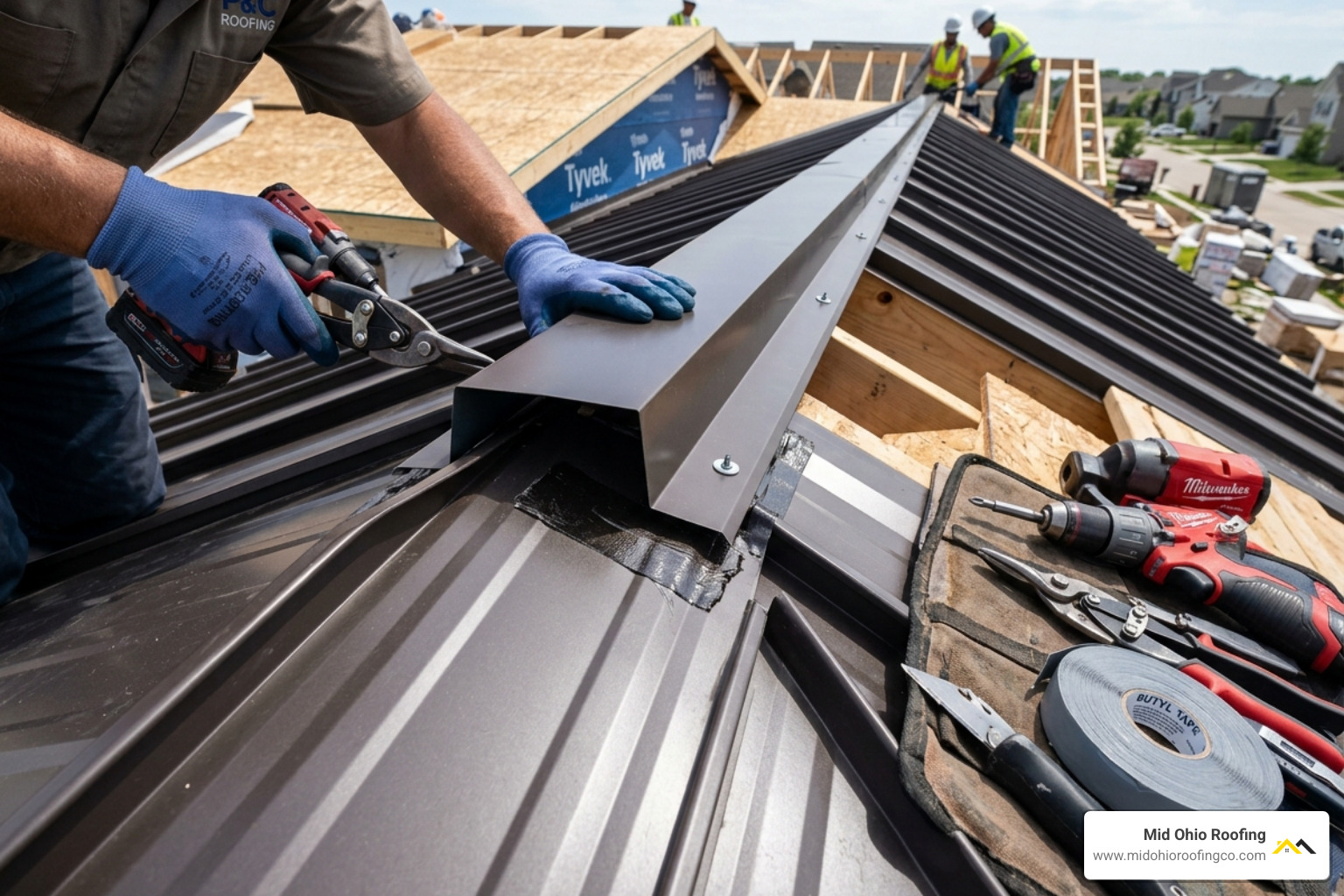
Before the ridge cap goes on, the panels must be ready. A key industry rule is to subtract 2 inches from your panel lengths at the ridge. This provides the necessary clearance for the Z-closures and ensures the panels don’t “bottom out” against each other at the peak.
For every 10 feet of ridge, you will need 20 feet of Z-closures (one for each side).
- Layout: Snap a chalk line along the ridge to ensure your Z-closures are perfectly straight.
- Sealant: Apply a continuous strip of double-sided butyl tape to the bottom of the Z-closure.
- Fastening: Secure the Z-closure through the roof panel and into the decking using pancake head screws. Following SMACNA guidelines for fastener spacing ensures the assembly can withstand high wind uplift.
If you are dealing with a damaged roof, our roof replacement services often involve upgrading these closures to ensure a much tighter seal than the original builder provided.
Securing the Ridge Cap and Finishing Gable Ends
Once the Z-closures are in place, it’s time for the “cover.”
- Cleat System: Many high-end ridge caps, like the MSR 100, use a cleat. You fasten the cleat to the ribs of the panels and then slide or snap the ridge cap over it. This hides the fasteners entirely.
- Hems: If you aren’t using a cleat, the ridge cap will have “hems” (folded edges) that hook onto the Z-closures.
- Overlaps: When joining two 10-foot sections, overlap them by at least 6 inches. Apply a bead of sealant between the metal layers and secure with pop rivets.
- Gable Ends: The most common place for leaks is the end of the ridge. You must cut and fold the end of the standing seam ridge cap to “box” it in, then seal the joints with high-quality silicone.
Rather have a pro on the ridge?
Ridge cap work is doable for a confident DIYer, but mistakes up there are expensive to find later. Mid Ohio Roofing installs and repairs standing seam systems across Central Ohio — see our metal roofing services or call (740) 644-2257 for a free assessment before you climb.
Advanced Considerations for Roof Pitch and Integration
Roof pitch significantly affects how a ridge cap performs. Most manufacturers, such as those producing the MasterRib® Ridge Cap 29 Gauge, recommend a minimum pitch of 3/12. On very steep roofs (up to 14:12), the angle of the ridge cap must be custom-bent to match the slope precisely, or the “wings” of the cap won’t sit flat against the Z-closures.
When we provide residential roofing services, we also look at how the ridge integrates with other features. For example, where a ridge meets a “hip” (a sloping ridge), specialized transition “caps” or custom-fabricated metal miters are required to maintain the watertight seal.
Handling Custom Sizing and Overlaps
Standard ridge caps come in 10-foot or 10’6″ lengths. However, no roof is perfectly divisible by ten.
- Custom Fabrication: We often custom-bend ridge caps to provide wider “wings” (e.g., 7 inches per side) for better coverage on steep slopes.
- Nominal vs. Actual: Always account for the “nominal” measurement. A 10-foot piece might lose 6 inches to an overlap, meaning you actually only get 9.5 feet of coverage per piece.
Performance Ratings and Warranty Standards
A standing seam ridge cap is part of a system that should last 50 years or more.
- Wind Uplift: Look for UL-90 rated systems. This rating, verified by UL Solutions, ensures the ridge won’t blow off during the severe thunderstorms we see in Central Ohio.
- Fire Resistance: Metal is naturally Class A fire-rated, providing peace of mind in wooded areas.
- Underlayment: We recommend high-performance synthetic underlayments like Sharkskin Ultra. These often come with 50-year warranties and provide a secondary “water barrier” beneath the metal.
Frequently Asked Questions about Standing Seam Ridge Caps
How much Z-closure is needed for a 10-foot ridge cap?
You need 20 linear feet of Z-closure for every 10 feet of ridge. This is because you must install a closure on both the left and right slopes of the roof peak.
What is the difference between a fixed and floating ridge?
A fixed ridge pins the panels at the top, forcing them to expand downward. A floating ridge allows the panels to move at the top, which requires them to be pinned at the eave. Fixed ridges are the standard for most Ohio homes.
Can I install a ridge cap on a roof with a low pitch?
Most standing seam ridge caps require a minimum pitch of 3/12. For “low slope” roofs (below 2/12), a standard ridge cap may not be sufficient, and a mechanically seamed system with specialized waterproof membranes is often required.
Conclusion
Installing a standing seam ridge cap like a pro requires patience, the right tools, and a deep understanding of how metal moves. From selecting the right 24-gauge steel to ensuring your Z-closures are sealed with double-sided butyl tape, every step is vital for a leak-free home.
At Mid Ohio Roofing, we bring years of local expertise to every project in Mount Perry, Columbus, and across Central Ohio. We understand the unique demands our weather puts on a metal roof, and we pride ourselves on transparent pricing and professional installation that stands the test of time.
If you’re ready to upgrade your home with a lifetime metal roofing system, or if you need a professional to handle a tricky ridge installation, we are here to help. Get a free metal roofing quote online from Mid Ohio Roofing to secure your home today.