


- Services
- Flat Roof Systems
Flat Roof Systems for Commercial Buildings
Flat Roof Systems
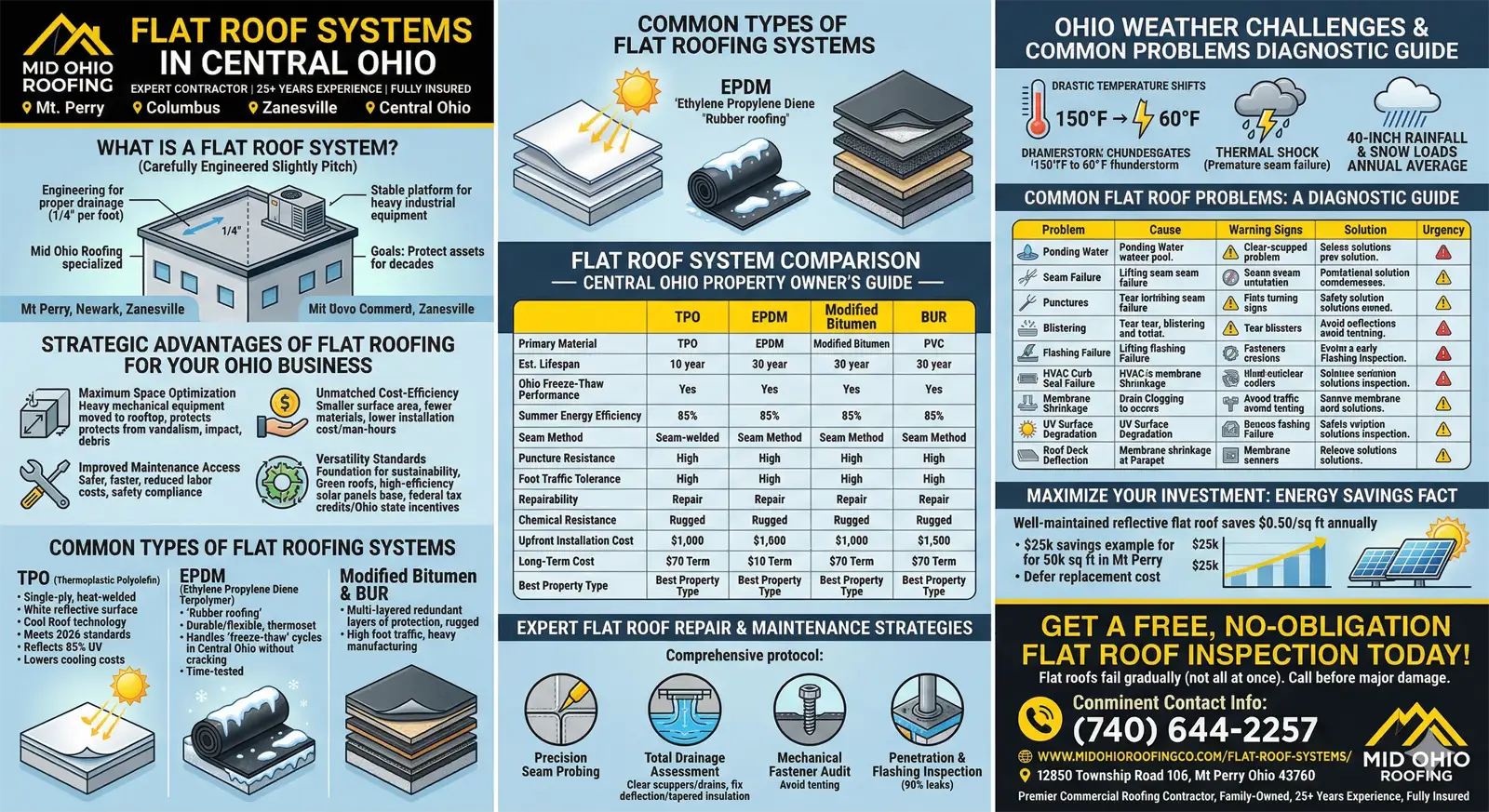
When it comes to commercial architecture, flat roof systems are the standard for versatility, cost-efficiency, and functionality. However, the term “flat” is actually a bit of a misnomer. These systems are carefully engineered with a slight pitch, often as little as 1/4 inch per foot, to ensure proper drainage while providing a stable platform for heavy industrial equipment. At Mid Ohio Roofing, we specialize in the design, installation, and roof repairs of high-performance flat roofing tailored to the unique demands of the Ohio climate.
As a family-owned business with over 25 years of experience, we serve as the premier commercial roofing contractor for Mt Perry, Newark, Zanesville, and the surrounding areas. We understand that a commercial roof is a major capital investment, and our goal is to provide a flat roof system that protects your assets for decades.
The Strategic Advantages of Flat Roofing for Ohio Businesses
Flat roofs are the preferred choice for industrial and warehouse facilities for several practical reasons. Beyond the initial cost savings compared to steep-slope roofs, they offer operational advantages that help your business run more smoothly.
Why These Benefits Matter for Your Bottom Line:
- Maximum Space Optimization: Flat roofs allow you to move bulky mechanical equipment, such as industrial AC units and heavy-duty vents, off the ground and onto the rooftop. This saves valuable real estate around your building and protects expensive units from ground-level vandalism, accidental vehicle impacts, or debris.
- Unmatched Cost-Efficiency: Because the surface area of a flat roof is smaller than a pitched roof covering the same square footage, significantly fewer materials are required. This efficiency translates to a lower roof installation cost and fewer man-hours during the initial build or replacement.
- Improved Maintenance Access: Maintaining a flat surface is safer and faster for your facility staff and third-party technicians. Whether they are performing roof leak detection or servicing solar arrays, the ease of movement reduces labor costs and increases safety compliance.
- Versatility Standards: Modern flat roofs are the perfect foundation for sustainability. They can be converted into “green roofs” to manage stormwater or used as a high-efficiency base for solar panels, which are increasingly supported by federal tax credits and Ohio state energy incentives.
roofing
Our Services
Roofing Services
Our crews are trained in the latest safety protocols, material handling, and installation techniques. Each member is vetted, insured, and committed to getting the job done right the first time. We frequently complete OSHA-certified safety training and maintain up-to-date licenses.
- Roof Inspections
- Roof Repairs
- Roof Leak Detection
- Emergency Roofing
- Structural & Sagging Roof Repair
- Residential Roofing
- Asphalt Shingle Roofing
- Shingle Certifications and Brands
- Roof Replacement
- Roof Installation
- Metal Roofing
- Storm Damage Roofing
- Emergency Tarping
- Hail Damage Roof Repair
- Wind Damage Roof Repair
- Commercial Roofing
- TPO Roofing
- EPDM Roofing
- Flat Roof Systems
Common Types of Flat Roof Systems We Install
Not all flat roofs are created equal. Depending on your building’s usage, whether it’s a high-moisture food processing plant or a temperature-controlled logistics hub, the choice of membrane is critical for long-term performance.
TPO (Thermoplastic Polyolefin)
TPO is a single-ply, heat-welded membrane that has become the industry favorite. Its white, reflective surface is a “Cool Roof” technology that helps businesses meet 2026 energy standards by reflecting up to 85% of UV rays, directly lowering interior cooling costs.
EPDM (Ethylene Propylene Diene Terpolymer)
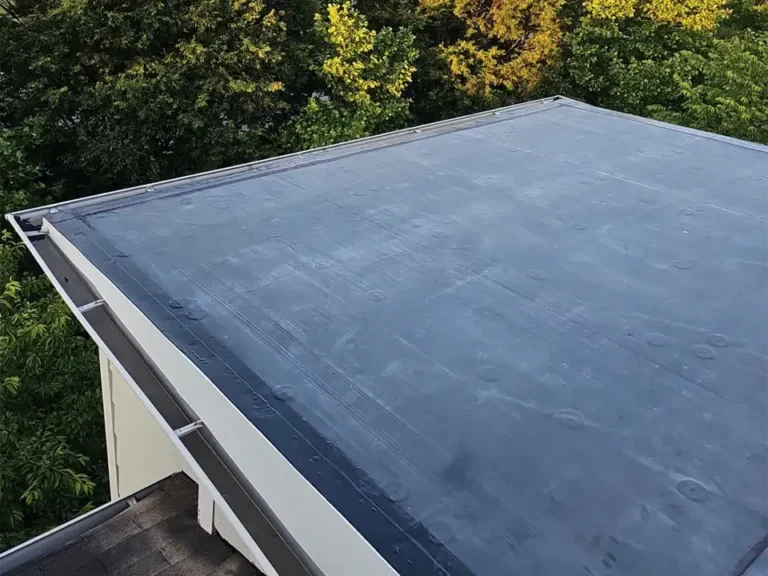
Often called “rubber roofing,” EPDM roofing is incredibly durable and flexible. It is a thermoset material, meaning its chemical bonds are cross-linked, allowing it to handle the extreme “freeze-thaw” cycles of Central Ohio without cracking. It is an excellent, time-tested choice for large-scale industrial projects.
Modified Bitumen and Built-Up Roofing (BUR)
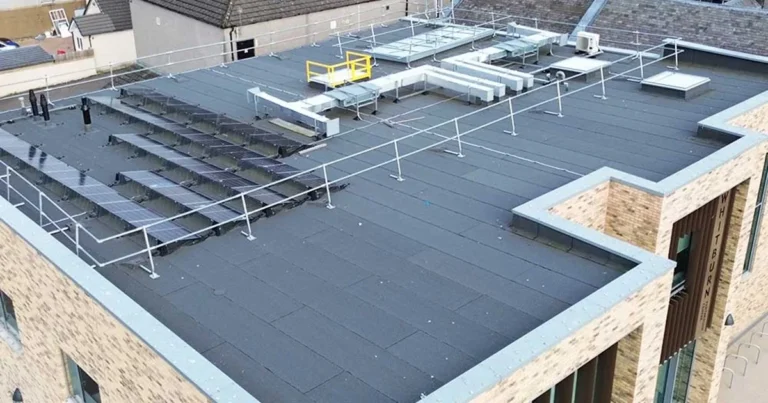
For buildings that experience high foot traffic or house heavy manufacturing equipment that may cause vibrations, multi-layered bitumen systems provide redundant layers of protection. These are rugged systems often used on older industrial buildings where a heavy-duty structural roof repair has been performed.
Flat Roof System Comparison — Choosing the Right Membrane for Your Central Ohio Property
Not all flat roofing systems perform the same way, and the right choice for your Central Ohio property depends on your building type, operational demands, energy goals, budget, and long-term ownership plans. This comprehensive comparison helps Ohio business owners and property managers evaluate the most commonly installed flat roof systems side by side across every factor that matters for performance and value.
Comparison Factor | TPO | EPDM | Modified Bitumen | Built-Up Roofing (BUR) | PVC |
Primary Material | Thermoplastic polyolefin membrane | Synthetic rubber membrane | Asphalt-based multi-layer system | Multiple asphalt and felt layers | Polyvinyl chloride membrane |
Estimated Lifespan | 20 – 30 years | 25 – 35 years | 15 – 20 years | 15 – 30 years | 20 – 30 years |
Ohio Freeze-Thaw Performance | Very Good — flexible in cold temperatures | Excellent — most flexible at extreme low temperatures | Good — multiple layers provide redundancy | Good — layered system manages thermal movement | Good — less flexible than EPDM in extreme cold |
Summer Energy Efficiency | Excellent — white reflective surface | Fair — dark surface absorbs solar heat | Fair — limited reflectance options | Fair — dark surface absorbs heat | Excellent — white reflective surface |
Seam Method | Heat-welded — strongest bond available | Taped or glued adhesive | Torch-applied or cold-adhesive | Hot mopped asphalt layers | Heat-welded — equal to TPO |
Puncture Resistance | High — reinforced fabric scrim | Moderate — susceptible to foot traffic | High — multiple redundant layers | Very High — thickest system available | High — reinforced fabric scrim |
Foot Traffic Tolerance | Moderate — walkway pads recommended | Moderate — walkway pads recommended | Good — multi-layer system handles moderate traffic | Excellent — heaviest duty flat roof option | Moderate — walkway pads recommended |
Repairability | Moderate — requires heat welding | Excellent — easiest to patch | Good — torch or cold-applied repair | Moderate — layer-by-layer repair required | Moderate — requires heat welding |
Chemical Resistance | Good | Moderate | Fair | Fair | Excellent — grease and chemical resistant |
Upfront Installation Cost | Moderate | Moderate | Moderate | Higher — labor intensive | Higher |
Long-Term Cost of Ownership | Low — energy savings offset cost | Very Low — long lifespan | Moderate — shorter replacement cycle | Moderate | Low |
Best Property Type | Warehouses, retail, office buildings | Large industrial, cold climate | High foot traffic, heavy vibration buildings | Older industrial buildings needing heavy-duty system | Restaurants, chemical plants |
Ohio Weather: Managing the 40-Inch Rainfall Challenge
In Mt Perry and the broader Ohio Valley, flat roofs face specific environmental stressors that require expert engineering. According to the National Weather Service (NWS), Central Ohio can experience over 40 inches of rainfall and significant snow loads annually. This makes “ponding water”, water that sits on a roof for more than 48 hours, the primary enemy of flat roof systems.
Furthermore, data from the National Roofing Contractors Association (NRCA) suggests that thermal shock is the leading cause of premature seam failure in the Midwest. When an Ohio roof heats up to 150°F in the afternoon sun and then cools rapidly to 60°F during a sudden evening thunderstorm, the material expands and contracts violently. Without professional installation by an experienced team, these movements can pull apart the seams and lead to catastrophic leaks.
Expert Flat Roof Repair and Maintenance Strategies
If you have noticed “bubbles” in your membrane or water stains on your ceiling, you may be searching for “flat roof patching.” While minor patching can provide a temporary fix, we believe in systemic restoration to avoid the high cost of interior storm damage.
Our Comprehensive Repair Protocol:
- Precision Seam Probing: Our technicians manually check every inch of the heat-welded or taped seams using specialized tools. We look for gaps that indicate the adhesive or weld is failing due to age or thermal stress.
- Total Drainage Assessment: We clear scuppers, gravel stops, and internal drains to ensure water moves off the roof immediately. We also check for “deflection” in the roof deck which may require tapered insulation to fix.
- Mechanical Fastener Audit: On mechanically attached systems, we ensure that high Ohio winds haven’t loosened the plates securing the membrane. Loose fasteners can lead to “tenting,” where the membrane pulls away from the building during a storm.
- Penetration & Flashing Inspection: We meticulously inspect the “boots” around HVAC units, pipes, and vents. Statistics show that 90% of flat roof leaks occur at these penetration points rather than in the field of the roof itself.
Why Property Owners Choose Mid Ohio Roofing
- Family Owned & Locally Accountable — We are not a national franchise sending unfamiliar crews to your building, we are a locally rooted Ohio business that puts our name and reputation behind every flat roof system we install across Central and Southeast Ohio.
- Fully Insured — Every flat roof project we complete is fully covered from first inspection through final walkthrough, protecting your property, your building contents, and our team with zero liability exposure for you.
- 25+ Years of Flat Roofing Experience — Decades of hands-on flat roof installation, repair, and maintenance experience across Central Ohio means we have encountered and solved every flat roofing challenge Ohio’s climate and commercial building stock can present.
- Comprehensive Flat Roof System Knowledge — We work across all major flat roofing systems, TPO, EPDM, modified bitumen, built-up roofing, and coatings, which means our recommendations are based on what genuinely fits your building, not on what we happen to stock.
- Drainage-First Installation Approach — We treat proper flat roof drainage as the foundation of every project, because a flat roof without engineered drainage is simply a slow-motion leak waiting to happen, and we design every system with that reality in mind.
- Repair, Restore, or Replace, Honest Guidance Every Time — We assess every flat roof based on its actual condition and give you a straightforward recommendation, whether that is a targeted membrane repair, a cost-saving coating restoration, or a full system replacement, with no pressure and no unnecessary upsells.
- Workmanship and Manufacturer Warranty on Qualifying Projects — Every qualifying flat roof project is backed by workmanship warranty coverage, and the systems we install carry manufacturer warranty options, giving your property both labor and material protection from day one.
Common Flat Roof Problems in Ohio — Causes, Warning Signs & Recommended Solutions
Flat roofs in Central Ohio face a unique combination of challenges, from summer UV exposure and thermal shock to winter snow loads and freeze-thaw cycling, that accelerate wear and create specific failure patterns that property owners need to recognize early. This diagnostic guide covers the most common flat roof problems Mid Ohio Roofing encounters across commercial and residential properties in the region.
Problem | Primary Cause | Warning Signs | Recommended Solution | Urgency Level |
Ponding Water | Inadequate drainage design, clogged drains, or roof deck deflection | Water standing on roof surface more than 48 hours after rain | Drain clearing — tapered insulation installation — drainage redesign | High — ponding accelerates membrane degradation and adds structural load |
Seam Failure or Separation | Age, thermal cycling stress, or poor original installation | Visible seam lifting, water staining near seam lines, active interior leak | Professional seam re-welding or re-taping with compatible materials | High — failed seams allow direct water entry |
Membrane Puncture or Tear | Foot traffic, HVAC service work, or falling debris | Visible holes or tears in membrane surface | Compatible membrane patch repair | High — punctures allow immediate water entry |
Membrane Blistering | Trapped moisture or air beneath membrane during installation | Raised bubbles or blisters on membrane surface | Professional assessment — puncture and re-bond or section replacement | Moderate — blisters accelerate membrane failure |
Flashing Failure at Transitions | UV degradation, thermal movement, or poor original installation | Water staining at wall base — visible flashing separation — active leak | Flashing repair or full replacement with compatible material | High — flashing is the primary leak source on flat roofs |
HVAC Curb Seal Failure | Thermal movement at penetration points — aging sealant | Water staining around rooftop equipment | HVAC curb flashing repair or replacement | High — 90% of flat roof leaks occur at penetration points |
Membrane Shrinkage | Material aging causing contraction at edges and perimeter | Flashing pulling away from walls — visible tension in membrane | Professional assessment — flashing repair or membrane perimeter resetting | High — shrinkage accelerates edge and flashing failure |
Drain Clogging | Debris accumulation blocking primary drains and scuppers | Water pooling near drains — overflow at scuppers during rain | Professional drain clearing and drainage system inspection | Moderate to High — blocked drains cause rapid ponding |
UV Surface Degradation | Long-term UV exposure on aging membrane surface | Chalky or brittle membrane surface appearance | Reflective coating application to restore UV protection | Moderate — surface degradation precedes membrane cracking |
Roof Deck Deflection | Long-term moisture damage or structural overloading | Visible low spots or sagging in roof surface — persistent ponding in same location | Structural assessment — tapered insulation or deck repair | Critical — deflection indicates potential structural concern |
Membrane Shrinkage at Parapet | Thermal cycling pulling membrane away from parapet wall | Gap visible between membrane and parapet — water entry at wall base | Parapet flashing repair and membrane termination resetting | High — parapet leaks cause significant interior wall damage |
Maximizing Your Investment: The Energy Savings Fact
A flat roof can last 20 to 30 years, but only with proper care. We offer custom roofing maintenance tips and professional roof inspections to help you defer the cost of a full roof replacement.
According to the U.S. Department of Energy — Cool Roofs, a well-maintained reflective flat roof can save a business up to $0.50 per square foot in annual energy costs. For a 50,000-square-foot warehouse in Mt Perry, that equals $25,000 in annual savings, far exceeding the cost of a comprehensive maintenance program.
Testimonials
What They’re Saying About Us
Frequently Asked Questions
How much does a commercial flat roof replacement cost in Ohio?
In 2026, the average cost for a commercial flat roof replacement in Central Ohio typically ranges from $6.00 to $12.00 per square foot. The final price depends on the material chosen (TPO vs. EPDM), the amount of tapered insulation required for proper drainage, and whether we need to perform a full tear-off to the structural roof deck.
Which flat roof system is best for Central Ohio’s extreme weather?
For Ohio businesses, we generally recommend TPO roofing for its superior UV reflection in the summer, or EPDM roofing for its incredible flexibility during our sub-zero winter “freeze-thaw” cycles. If your building houses heavy machinery or has high foot traffic, a multi-layer modified bitumen system may be the most durable choice.
My flat roof in Ohio "ponding water"—is this a structural emergency?
“Ponding” is defined as water that remains on the roof for more than 48 hours after a storm. While it may not be an immediate emergency, it is a significant risk. Standing water acts as a magnifying glass for UV rays, degrading the membrane, and adds thousands of pounds of “dead load” to your structure. If you notice ponding, it’s time to schedule a roof inspection to evaluate your drainage or tapered insulation needs.
Does the "Ohio Matching Law" apply to flat roof repairs?
Yes. Under Ohio Administrative Code 3901-1-54, if your flat roof sustains storm damage, your insurance company is required to provide a repair that results in a “reasonably comparable appearance.” Because flat roof membranes fade and oxidize, a new patch often creates a technical mismatch. We specialize in documenting these issues to help our clients advocate for a full system replacement when a uniform look cannot be achieved.
Can I install solar panels or new HVAC units on my existing flat roof in Central Ohio?
Absolutely, but with a caveat. Before adding weight or penetrations to your roof, you should have a structural roof repair specialist or engineer verify the load-bearing capacity. We also strongly recommend installing walkway pads around any new equipment to protect the membrane from the increased foot traffic required for maintenance.
How often should I have my commercial flat roof inspected?
We recommend professional inspections twice per year, once in the spring to check for winter ice damage and once in the fall to clear drains of debris before the snow hits. Regular roofing maintenance is often a requirement to keep your 20- or 30-year manufacturer warranty valid.
Get in Touch with Us
Mid Ohio Roofing
12850 Township Road 106, Mount Perry, OH, 43760
Monday: 8AM – 8PM
Tuesday: 8AM – 8PM
Wednesday: 8AM – 8PM
Thursday: 8AM – 8PM
Friday: 8AM – 8PM
Saturday: 8AM – 8PM
Sunday: Closed
Quality roofing provider
Connect With Us
Mid Ohio Roofing
12850 Township Road 106, Mount Perry, OH, 43760
(740) 644-2257
Mon–Sat: 8 AM – 8 PM, Sun: Closed
