
Why Commercial Roof Replacement in Springfield, OH Demands a Different Approach
If you’re looking for commercial roof replacement in Springfield, OH, partnering with a trusted commercial roofing contractor is the best way to protect your investment. Here’s what you need to know right away:
- Commercial roofs typically last 15 to 30 years before replacement becomes more cost-effective than repeated repairs.
- Signs you need replacement include recurring leaks, ponding water, membrane blisters, structural sagging, and rising energy bills.
- Common systems used in Springfield include TPO, EPDM, PVC, metal, and built-up roofing (BUR).
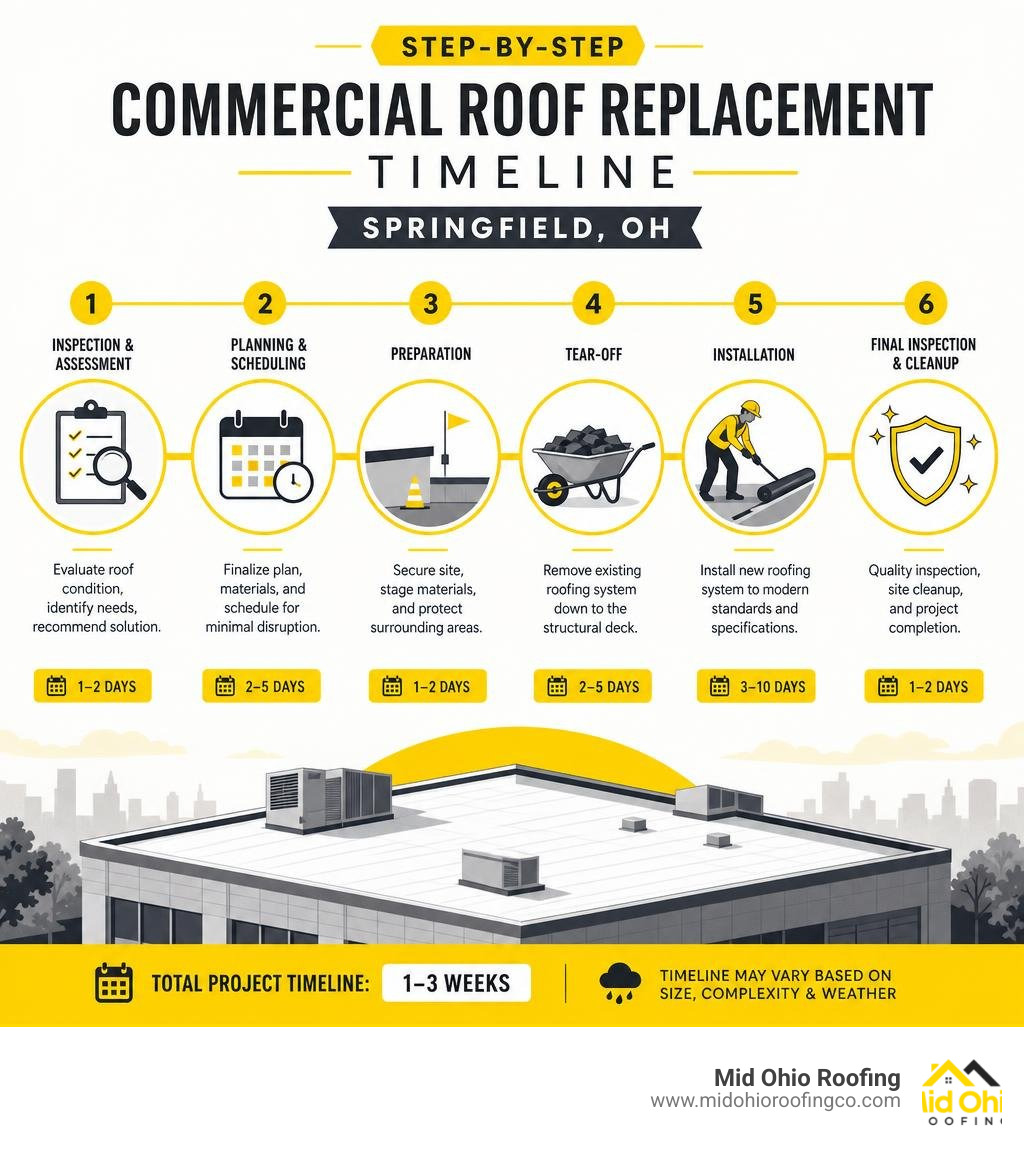
- Average project timeline ranges from 1 to 3 weeks depending on roof size, material, and weather.
- Springfield’s freeze-thaw cycles and heavy storms accelerate roof wear faster than in milder climates.
- Most businesses can stay open during replacement with proper phased installation and scheduling.
Springfield, Ohio sits squarely in Clark County’s four-season climate — and that climate is hard on commercial roofs. Winters bring freeze-thaw cycles that stress membrane seams. Springs arrive with heavy rain and severe storms. Summers add UV exposure and heat load. By the time a commercial roof starts failing visibly, it has often been deteriorating from the inside out for months or years.
A reactive approach to commercial roofing is one of the most expensive mistakes a property owner can make. Emergency repairs, interior water damage, and business downtime all cost far more than a planned replacement on your terms. The National Roofing Contractors Association (NRCA) consistently emphasizes that proactive maintenance and timely replacement are the most reliable ways to protect a commercial building investment.
Mid Ohio Roofing provides professional roof replacement services across Springfield and the surrounding region, helping business owners make informed decisions before small problems become structural ones.
I’m Albert Wengerd, owner of Mid Ohio Roofing, with hands-on experience in commercial roofing systems including TPO, EPDM, and flat roofing — the same systems most commonly used in commercial roof replacement in Springfield, OH. This guide covers everything you need to make a confident, informed decision about your building’s roof.
Key Indicators for Commercial Roof Replacement Springfield OH
Determining when to replace a commercial roof is a critical financial decision for any property owner. Commercial roofing systems do not fail overnight; instead, they show progressive, physical warning signs that indicate the membrane or structural deck has reached the end of its useful service life.
To prevent catastrophic structural damage or costly business interruptions, look for these definitive physical signs during your routine building walk-throughs:
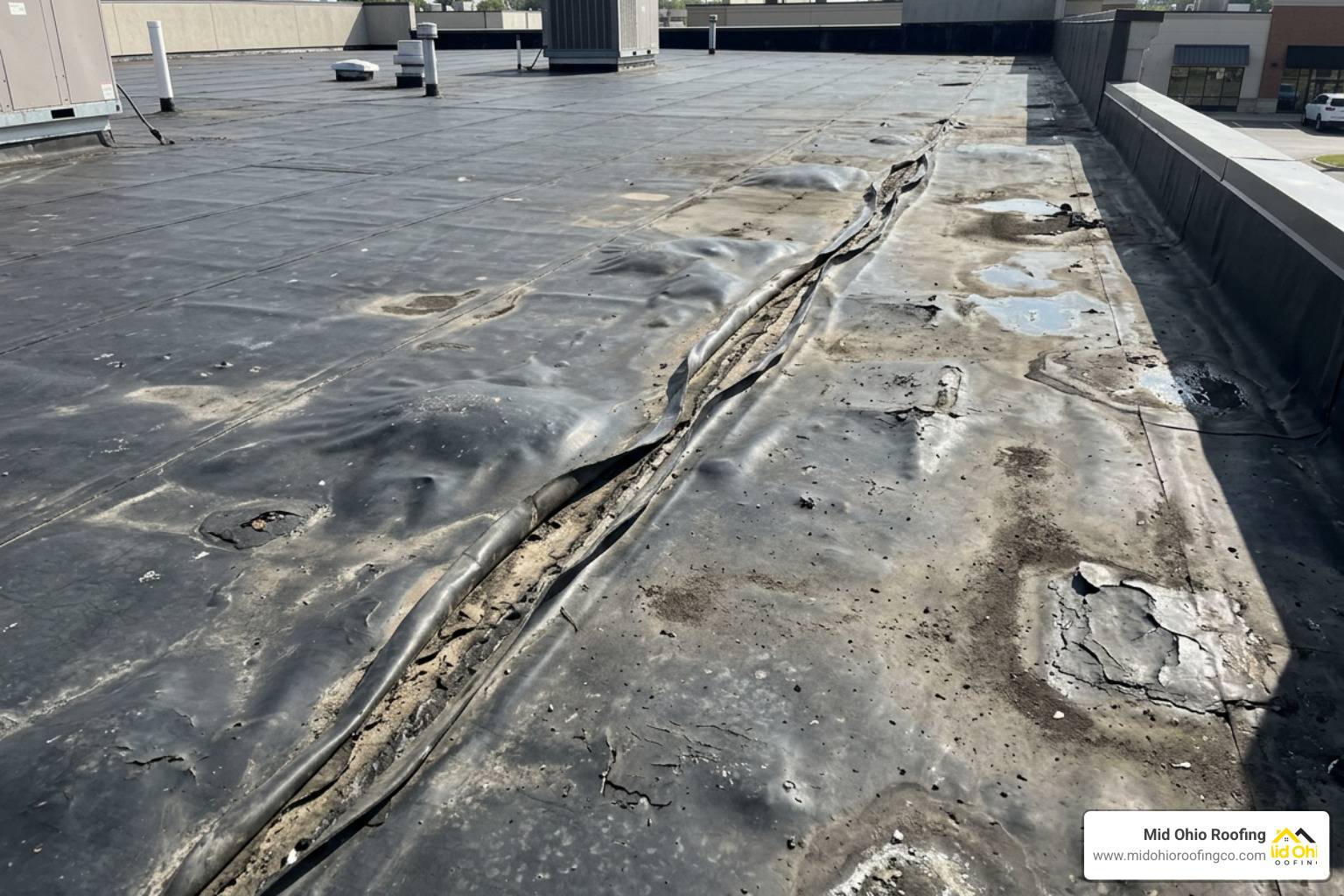
- Ponding Water: If water remains on a flat roof for more than 48 hours after rain, the drainage system is failing or the roof deck has begun to sag. Ponding water accelerates membrane degradation and introduces immense physical weight.
- Membrane Blisters and Splits: Bubbles or blisters in single-ply membranes (TPO, PVC, EPDM) indicate that moisture has penetrated the outer layer and is trapped beneath, heating up and expanding under the Ohio sun.
- Recurring Interior Leaks: If your facility experiences leaks in the same locations despite multiple repair attempts, water has likely saturated the underlying insulation, creating a hidden reservoir.
- Separating Seams: The seams are the weakest point of any membrane roof. When adhesive or welds fail, wind can easily lift the membrane, exposing the substrate below to direct rainfall.
- Structural Sagging: Visible dipping or bowing in the roofline from the interior or exterior is an emergency indicator that water damage has compromised the wood or steel structural deck.
While some surface wear is normal, hidden moisture trapping can cause quiet rot inside your roof deck. Utilizing professional commercial roof inspections is the only way to accurately map moisture levels using infrared technology before deciding on a replacement path.
When to Choose Commercial Roof Repairs vs. Commercial Roof Replacement Springfield OH
To determine whether to repair or replace your commercial roof, apply the 25% Rule: if the cost of necessary repairs exceeds 25% of the total cost of a complete roof replacement, investing in a new roof is the more financially sound decision.
Additionally, consider the following factors:
- Age of the Roof: If your system is approaching the 15- to 20-year mark, repeated repairs are often just temporary fixes on a failing asset.
- Scope of Damage: If more than 25% of the roof membrane or underlying insulation is saturated or damaged, spot repairs will not restore structural integrity.
- Frequency of Leaks: If you are calling for commercial roof repairs multiple times a year, those cumulative operational disruptions and emergency fees will quickly surpass the cost of a planned capital replacement.
How Springfield Weather Accelerates Commercial Roof Deterioration
Springfield, Ohio, experiences a dynamic, four-season climate that places severe physical stress on commercial roofing materials. The primary driver of rapid roof aging in Clark County is the winter freeze-thaw cycle. When snow or rain falls, moisture seeps into micro-cracks, seams, and flashing. As temperatures drop below freezing, this water expands by roughly 9%, physically widening those gaps. When it thaws, the water travels deeper, repeating the destructive cycle day after day.
Furthermore, severe spring and summer thunderstorms bring high winds and heavy downpours. High winds can cause membrane uplift, pulling single-ply roofs away from their fasteners. Heavy rainfall tests the limits of flat roof drainage systems, leading to localized flooding on the roof surface. If your building has suffered sudden storm damage, utilizing rapid storm damage roofing assessments is crucial to secure the structure before water ruins inventory or electrical systems.
Comparing Commercial Roofing Systems: TPO, EPDM, PVC, and Metal
Every commercial building has unique structural demands, weight tolerances, and budget constraints. When planning a commercial roof replacement in Springfield, OH, selecting the right material is the single most important factor determining your long-term return on investment.
Below is a comparative breakdown of the most common commercial roofing materials used in Central Ohio:
| Roofing Material | Average Cost per Sq. Ft. | Lifespan | Solar Reflectivity | Key Strengths |
|---|---|---|---|---|
| TPO (Thermoplastic Polyolefin) | Moderate | 15 – 25 Years | High (Excellent) | Highly reflective, heat-welded seams, budget-friendly |
| EPDM (Synthetic Rubber) | Low to Moderate | 20 – 30 Years | Low (Unless coated) | Extremely durable, handles thermal shock, easy to patch |
| PVC (Polyvinyl Chloride) | Higher | 20 – 30 Years | High (Excellent) | Chemically resistant, fire-resistant, incredibly strong seams |
| Metal (Standing Seam) | High | 40 – 60 Years | Moderate to High | Ultimate longevity, low maintenance, wind-resistant |
| BUR (Built-Up Roofing) | Moderate to High | 20 – 30 Years | Low (Unless graveled) | Redundant waterproofing layers, highly puncture-resistant |
For businesses looking to match local standards, referencing Columbus commercial roofing specifications can provide a highly reliable blueprint, as both regions share identical climate challenges and structural building codes.
TPO and PVC Membranes for Energy Efficiency
Thermoplastic single-ply membranes like TPO and PVC are the gold standard for modern “cool roofs.” These bright white membranes feature a high Solar Reflectance Index (SRI), meaning they reflect the majority of the sun’s solar radiation back into the atmosphere rather than absorbing it into your building.
By keeping the roof surface significantly cooler, TPO and PVC systems dramatically reduce the heat load transferred into your facility. This lowers your peak cooling demands and slashes summer HVAC energy consumption. For businesses operating large facilities in the region, studying Cincinnati commercial roofing options reveals a strong regional trend toward white single-ply membranes to combat urban heat island effects.
We highly recommend selecting Energy Star certified roof products to maximize your utility savings and ensure compliance with modern green building standards. You can also explore local commercial projects in neighboring markets, such as Columbus Commercial Roofing, to see how regional enterprises leverage reflective technology to reduce operating overhead.
EPDM and Metal Roofing for Long-Term Durability
For property owners who prioritize absolute physical durability and wind resistance over solar reflectivity, EPDM and standing seam metal roofs are unmatched.
EPDM is a synthetic rubber membrane known for its incredible elasticity. It can stretch and contract during Ohio’s extreme temperature swings without cracking or tearing. Because it is highly resistant to ozone and UV radiation, EPDM is a popular choice for warehouses and industrial plants throughout Ohio.
Standing seam metal roofing represents the ultimate long-term investment. By utilizing raised interlocking seams that sit above the water level, metal roofs eliminate the risk of seam leakage. They easily withstand high wind events, hail, and heavy snow loads.
When choosing these heavy-duty systems, it is essential to work with certified installers. At Mid Ohio Roofing, we install industry-leading GAF commercial roofing systems to ensure your investment is backed by robust, multi-decade manufacturer warranties.
If you have properties in surrounding areas, we also provide these high-durability systems across our service regions, including Newark, New Albany, Zanesville, and Athens. No matter where your facility is located, selecting a durable commercial system is the key to securing your physical assets.
The Step-by-Step Commercial Roof Replacement Process
A successful commercial roof replacement relies on a highly coordinated, multi-phase execution plan. Here is exactly what you can expect when we replace your commercial roof:
- Pre-Project Planning: We conduct a thorough on-site evaluation, take core samples to check for hidden insulation moisture, and finalize material choices.
- Safety Setup: We install safety barriers, warning lines, and debris chutes in strict compliance with OSHA safety regulations.
- Tear-Off and Deck Inspection: We remove the old membrane and saturated insulation down to the structural deck. We inspect the steel, concrete, or wood deck for rot or rust, making repairs as needed.
- Insulation Installation: We lay down new polyisocyanurate (polyiso) insulation boards, securing them mechanically or with low-rise adhesive to meet local R-value energy codes.
- Membrane Application: We install the new membrane (TPO, PVC, or EPDM), carefully welding the seams with specialized hot-air equipment or sealing them with heavy-duty seam tape.
- Flashing and Detailing: We seal all roof penetrations, including HVAC units, vents, pipes, and parapet walls, using reinforced flashing to prevent edge leaks.
- Zero-Trace Cleanup: We perform a meticulous site cleanup, including a triple-pass magnet sweep of all surrounding parking lots and walkways to collect stray fasteners.
- Final Inspection and Warranty Registration: We conduct a comprehensive joint walkthrough with the manufacturer’s inspector to certify the installation and issue your long-term warranty.
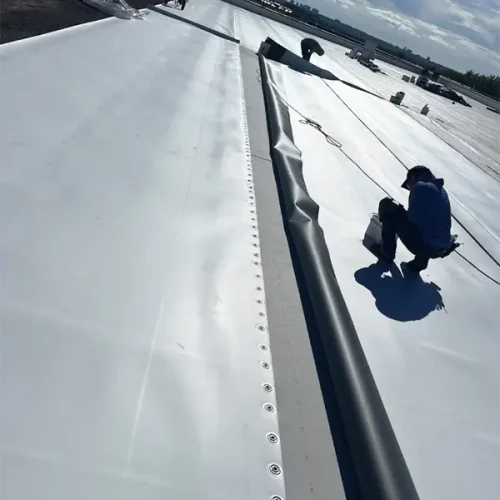
Minimizing Operational Disruption During a Commercial Roof Replacement Springfield OH Project
We understand that closing your doors during construction is not an option. To keep your business running smoothly, we implement three key strategies:
- Phased Installation: We tear off and replace only what can be made completely watertight in a single day. This prevents your building’s interior from ever being exposed to overnight weather.
- Strategic Material Staging: We coordinate crane deliveries and material staging zones away from customer parking lots and main entryways to keep traffic flowing safely.
- Off-Peak Scheduling: For highly disruptive or noisy tasks, such as drilling into concrete decks, we can perform work during off-peak hours or weekends.
Should unexpected weather occur during construction, our round-the-clock emergency roofing services are always on standby to secure your property immediately.
Navigating Springfield Building Permits and Code Compliance
Every major commercial roofing project in Clark County must strictly comply with local building regulations. Before any work begins, we coordinate with the City of Springfield Building Regulations department to secure the necessary commercial building permits.
Ohio building codes mandate specific wind-uplift resistance ratings and strict minimum insulation R-values (typically R-30 for flat roof replacements). Failing to pull permits or install a system to these standards can result in hefty city fines, delayed real estate transactions, or even voided insurance policies. Working with a contractor who understands Springfield roofing solutions ensures your project complies with all local zoning and safety codes from day one.
Frequently Asked Questions About Commercial Roofing in Springfield
How long does a typical commercial roof replacement take?
A typical commercial roof replacement takes between 1 to 3 weeks to complete. The exact timeline depends on the total square footage of the building, the complexity of the rooftop equipment (such as HVAC units and exhaust vents), the choice of roofing material, and local weather conditions. Simple single-ply membrane installations on wide-open warehouses proceed much faster than complex multi-level retail structures.
How often should a commercial roof be inspected after replacement?
You should schedule commercial roof inspections at least twice a year, ideally in the spring and fall. Spring inspections identify any physical stress caused by winter freeze-thaw cycles, while fall inspections ensure the drains, gutters, and seams are clear and secure before winter weather arrives. Regular inspections are often a mandatory requirement to keep your manufacturer’s NDL (No Dollar Limit) warranty valid.
Can a silicone roof coating delay the need for a full replacement?
Yes, a high-solids silicone roof coating can successfully delay a full replacement by 10 to 20 years, but only if the roof is a proper candidate. To qualify for a coating, the existing roof structure must be structurally sound, and moisture scans must confirm that the underlying insulation is completely dry. If the insulation is already saturated, applying a coating will trap the moisture inside, accelerating deck rot and structural failure.
Conclusion
A commercial roof replacement is a significant capital investment, but it is also an invaluable opportunity to secure your building, protect your operations, and lower your monthly energy bills. By choosing a high-performance single-ply or metal system tailored to Springfield’s demanding freeze-thaw cycles, you protect your inventory, employees, and bottom line for decades to come.
At Mid Ohio Roofing, we combine deep local expertise with transparent, fixed-price pricing and a commitment to safety. We never use high-pressure sales tactics; instead, we provide clear, photographic roof assessments so you can make the best decision for your business. From initial permit acquisition to our signature triple-pass magnet cleanup, we manage every step of the process with minimal disruption to your daily operations.
Ready to secure your commercial property with our comprehensive roofing services? Contact our commercial division today to schedule a professional consultation and custom roof assessment.