
Why Commercial EPDM Installation in Columbus Demands the Right Roofing Partner
Commercial EPDM installation in Columbus is one of the most reliable and cost-effective ways to protect a flat or low-slope commercial building from Ohio’s punishing weather. If you’re a business or property owner looking to hire an expert, partnering with a professional commercial roofing contractor in Columbus ensures your investment is fully protected. Here’s what you need to know at a glance:
Quick answers for Columbus commercial property owners:
- What is EPDM? A single-ply synthetic rubber membrane designed for flat and low-slope roofs
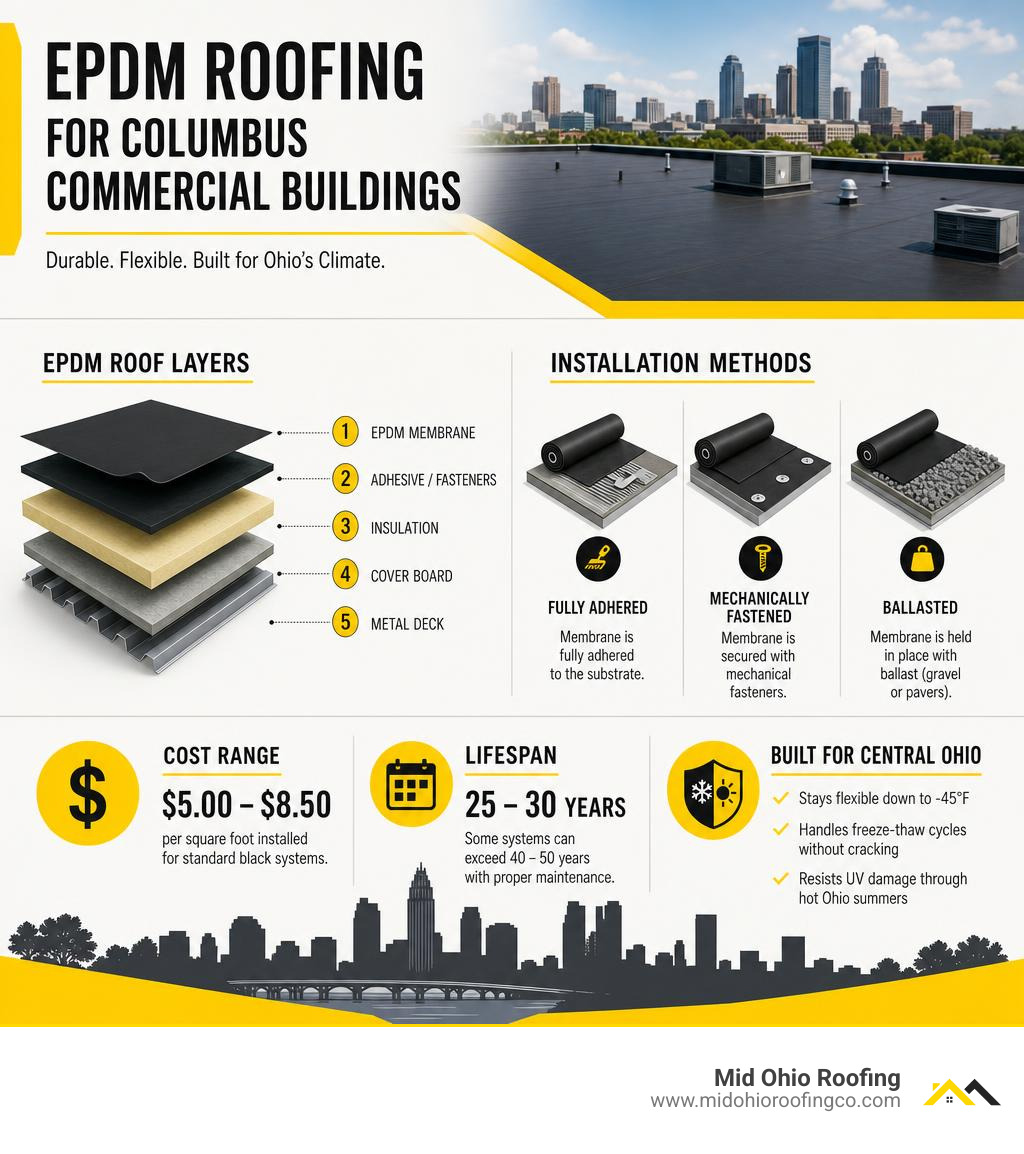
- How much does it cost? Typically $5.00–$8.50 per square foot installed for standard black systems
- How long does it last? A properly installed EPDM roof lasts 25–30 years, with some systems exceeding 40–50 years
- Why EPDM for Columbus? It stays flexible down to -45°F, handles freeze-thaw cycles without cracking, and resists UV damage through hot Ohio summers
- Installation methods: Fully adhered, mechanically fastened, or ballasted — each suited to different building types and budgets
Columbus businesses face a real challenge: a climate that swings from scorching summer heat to deep freezing winters, with heavy snow loads, hail, and heavy rain in between. That kind of weather punishes a weak roof fast. EPDM’s ability to expand and contract without losing structural integrity makes it one of the smartest membrane choices for commercial roofing in Columbus.
At Mid Ohio Roofing, we help Columbus-area property owners navigate every step of the process — from initial inspection to final seam sealing.
I’m Albert Wengerd, owner of Mid Ohio Roofing, and I’ve overseen commercial EPDM installation in Columbus and across Central Ohio, including warehouse flat-roof projects and full membrane replacements on aging commercial buildings. In this guide, I’ll walk you through everything you need to make a confident, well-informed roofing decision.
What is EPDM and Why is it Ideal for Central Ohio?
Ethylene Propylene Diene Monomer (EPDM) is a highly durable synthetic rubber single-ply roofing membrane. It is manufactured from a blend of ethylene, propylene, and a small amount of diene monomer, which creates an incredibly resilient, flexible, and chemically stable material.
Unlike thermoplastic materials that are welded together with heat, EPDM is a thermoset material. This means its molecular structure is chemically cross-linked during manufacturing. Once cured, it cannot be melted or reshaped, giving it outstanding dimensional stability and resistance to extreme environmental factors.
For commercial properties featuring low-slope or entirely flat roofs, choosing EPDM roofing is a highly reliable way to protect your physical assets. This material provides exceptional resistance to ozone, long-term UV exposure, and intense thermal shock.
Because it expands and contracts naturally, it is uniquely suited to handle the wide temperature swings common in Ohio without splitting, cracking, or degrading.
Why Commercial EPDM Installation Columbus is Ideal for Ohio Winters
In Central Ohio, winters bring heavy snow loads, ice accumulation, and rapid freeze-thaw cycles. When water finds its way into tiny cracks on a roof and freezes, it expands, widening those cracks and creating major leaks. EPDM excels at preventing this damage because of its remarkable physical properties:
- Extreme Cold Flexibility: EPDM remains highly flexible at temperatures as low as -45°F. It will not become brittle or crack, even during the coldest winter nights in Columbus.
- Elasticity and Recovery: The membrane can stretch up to 300% of its original size and return to its original shape. As your commercial building settles or shifts under heavy snow loads, the EPDM membrane stretches with it.
- Seamless Water Protection: Because EPDM is available in exceptionally large sheets (up to 50 feet wide by 100 feet long), a professional installation requires far fewer seams than other roofing materials, significantly reducing potential leak points.
By utilizing advanced membrane technology like Carlisle SynTec EPDM Systems, commercial properties gain a robust barrier that shrugs off winter weather year after year.
Black vs. White EPDM: Energy Efficiency in Columbus
When preparing for a commercial EPDM installation in Columbus, you will have to choose between a traditional black membrane and a reflective white membrane. The right choice depends on your building’s unique heating and cooling needs.

- Black EPDM (Carbon Black): Traditional black EPDM is formulated with carbon black, which absorbs solar heat. In Central Ohio—where we typically experience more heating degree days (cold winter months) than cooling degree days (hot summer months)—black EPDM can actually lower your winter heating costs by absorbing solar energy and transferring that heat into the building.
- White EPDM (Reflective Coating): White EPDM is coated with a titanium dioxide layer that reflects sunlight. According to the Cool Roof Rating Council, high-quality white EPDM membranes achieve an initial solar reflectance of roughly 77% and an aged reflectance of 66%. This drastically reduces the “heat island” effect and lowers summer cooling costs, making it the ideal choice for retail spaces, offices, or temperature-sensitive facilities like data centers.
EPDM vs. TPO vs. PVC: Commercial Membrane Comparison
Selecting the right single-ply membrane requires a clear understanding of how EPDM stacks up against other popular commercial options like Thermoplastic Polyolefin (TPO) and Polyvinyl Chloride (PVC).
| Performance Metric | EPDM (Synthetic Rubber) | TPO (Thermoplastic) | PVC (Thermoplastic) |
|---|---|---|---|
| Material Type | Thermoset (Rubber) | Thermoplastic (Plastic) | Thermoplastic (Plastic) |
| Expected Lifespan | 25–40+ Years | 15–25 Years | 20–30 Years |
| Seam Method | Seam Tape & Primer | Hot-Air Welded | Hot-Air Welded |
| Cold Weather Flexibility | Excellent (Down to -45°F) | Good (Can crack over time) | Fair (Can become brittle) |
| Chemical/Grease Resistance | Poor | Fair | Excellent (Best for restaurants) |
| Repairability | Extremely Easy (No special tools) | Moderate (Requires heat welder) | Moderate (Requires heat welder) |
| Average Installed Cost | $5.00 – $8.50 / sq. ft. | $6.00 – $10.00 / sq. ft. | $7.50 – $12.00 / sq. ft. |
Performance and Lifespan Metrics
EPDM stands out for its long-term durability. While TPO and PVC rely on plasticizers and stabilizers that can break down under constant UV exposure, EPDM’s synthetic rubber formula is inherently UV-stable.
According to data from the EPDM Roofing Association (ERA), properly maintained EPDM membranes have an expected service life of 38 years, with many well-installed roofs exceeding 40 to 50 years of continuous service.
Additionally, EPDM offers superb dimensional stability, meaning it won’t shrink or pull away from the roof edges over time. Its thick, rubberized composition also provides excellent puncture resistance against falling debris, light hail, and routine foot traffic.
For property owners seeking a long-term investment, scheduling an EPDM membrane rubber roof installation ensures your building remains protected for decades.
Cost Comparison and ROI
From a financial perspective, EPDM is highly competitive. Standard black EPDM is generally 10% to 20% less expensive to purchase and install than TPO, and up to 30% cheaper than high-end PVC systems.
Because EPDM does not require complex hot-air welding equipment during installation, labor costs are minimized. Over the lifespan of the roof, EPDM offers an incredibly low lifecycle cost.
Its simple repair process—requiring only cleaning, primer, and adhesive patches—means that any future maintenance or modifications (such as adding a new HVAC curb) can be completed affordably. When you weigh the initial installation savings against its 30+ year lifespan, EPDM delivers an exceptional return on investment (ROI).
To explore how these savings apply to your specific property, you can review our full range of commercial roofing services.
The Cost of Commercial EPDM Installation Columbus Projects
When budgeting for a commercial EPDM installation in Columbus, understanding local pricing and structural variables is key to avoiding unexpected expenses.
Every commercial building has unique architectural features, and our team works closely with property owners throughout Columbus, OH to provide accurate, transparent pricing.
Material and Labor Cost Breakdown
On average, a professional EPDM installation in Central Ohio ranges between $5.00 and $8.50 per square foot for standard black systems. Here is how those costs are typically distributed:
- Material Costs: Expect to pay between $1.50 and $4.00 per square foot for the EPDM membrane, cover tapes, bonding adhesives, flashing materials, and insulation boards.
- Labor Costs: Professional commercial roofing labor ranges from $2.50 to $6.00 per square foot. This covers the skilled labor required for substrate preparation, membrane laying, detailed flashing work, and certified seam sealing.
- Total Project Estimate: For a standard 10,000-square-foot commercial flat roof, a complete EPDM replacement generally ranges from $50,000 to $85,000, depending on the complexity of the roof layout.
Factors Influencing Your EPDM Replacement Budget
Several key variables will influence where your final estimate falls within the typical cost range:
- Membrane Thickness: EPDM is typically installed in thicknesses of 45-mil, 60-mil, or heavy-duty 90-mil. While a 90-mil membrane costs more upfront, it offers superior puncture resistance and can withstand severe hail.
- Insulation Requirements (R-Value): Building codes in Columbus require specific thermal insulation levels for commercial properties. Adding layers of Polyisocyanurate (Polyiso) board increases material costs but pays off through lower monthly energy bills.
- Roof Penetrations: Roofs with numerous HVAC units, vents, skylights, and drainage pipes require extensive hand-flashing, which increases labor time and cost.
- Existing Decking Condition: If the wood or steel decking beneath your old roof has suffered water damage or rot, it must be repaired or replaced before the new EPDM membrane can be installed.
Professional EPDM Installation Methods and Services
A commercial roof is only as good as the hands that install it. Proper substrate preparation, meticulous seam sealing, and correct edge termination are critical to preventing leaks.
At Mid Ohio Roofing, we follow manufacturer-approved guidelines on every roof installation to ensure your investment is fully protected.
Step-by-Step Commercial EPDM Installation Columbus Process
Our team follows a strict, multi-step process to ensure a flawless installation:
- Comprehensive Inspection & Core Sampling: We start by inspecting the existing roof and taking core cuts to analyze the underlying insulation and deck structure.
- Tear-Off and Substrate Preparation: We remove the old, failing roofing materials down to the structural deck. The surface is then thoroughly cleaned, dried, and cleared of any debris or sharp objects.
- Insulation Installation: High-performance Polyiso insulation boards are mechanically fastened or adhered to the deck to establish a flat, energy-efficient substrate.
- Membrane Laying: Large EPDM sheets are rolled out over the substrate and allowed to relax for at least 30 minutes to relieve any manufacturing tension.
- Seam Priming & Taping: We apply a specialized primer to the seam areas, followed by heavy-duty, manufacturer-approved seam tape. The seams are then pressed with a steel roller to create a watertight chemical bond.
- Flashing and Detailing: We install specialized EPDM flashing around all penetrations, curbs, and perimeter edges to prevent water intrusion.
- Final Inspection: A supervisor performs a final quality check to ensure every seam, flashing point, and edge termination meets our rigorous standards.
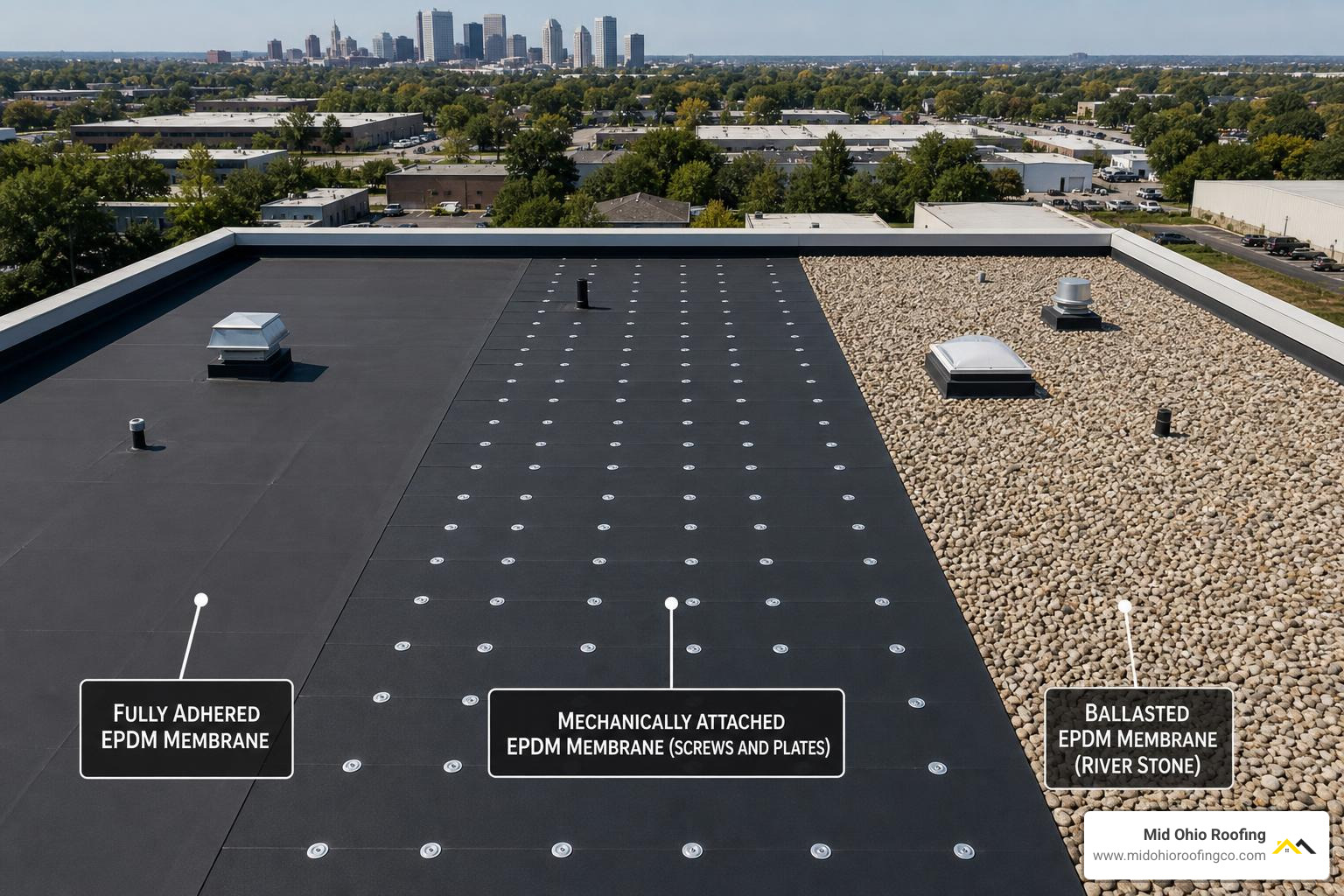
Fully Adhered, Mechanically Attached, and Ballasted Systems
EPDM can be secured to a building using three primary installation methods:
- Fully Adhered Systems: The insulation and EPDM membrane are bonded directly to the substrate using high-strength liquid adhesives. This is the most popular method in Columbus because it offers maximum wind uplift resistance and a smooth, clean appearance.
- Mechanically Attached Systems: The membrane is rolled out and secured to the structural deck using heavy-duty screws and plates along the seams. This method is highly cost-effective and fast to install, making it ideal for large warehouses.
- Ballasted Systems: The EPDM sheets are laid loosely over the substrate, sealed at the seams, and held in place by a heavy layer of river stones or concrete pavers. While this is the most economical option, the building structure must be strong enough to support the substantial added weight.
Common EPDM Roof Problems and Maintenance Solutions
While EPDM is incredibly durable, no roof is entirely maintenance-free. Staying proactive with routine inspections and timely repairs is the best way to maximize your roof’s lifespan and avoid costly business disruptions.
If you notice signs of wear, scheduling professional commercial roofing services quickly can prevent minor issues from turning into major structural damage.
Preventing Seam Failures and Ponding Water
The two most common issues flat roofs face are seam separation and standing water:
- Seam Failures: Unlike thermoplastic roofs with welded seams, EPDM seams are held together with adhesive tape. Over 15 to 20 years, constant exposure to standing water and UV rays can slowly degrade these adhesives. During our bi-annual inspections, we probe the seams to catch and reseal any minor separations before they leak.
- Ponding Water: Flat roofs must be designed with a slight slope to direct water toward drains and scuppers. If water stands on your roof for more than 48 hours, it accelerates membrane degradation and increases the risk of a leak. We resolve ponding issues by clearing clogged drains, installing tapered insulation to improve runoff, or adding new roof drains.
- Punctures: While EPDM is tough, sharp tools, windborne debris, or heavy foot traffic can puncture the membrane. Fortunately, EPDM is highly repairable; we can easily patch punctures using primer and self-adhering EPDM patches.
Ohio’s Matching Law and Insurance Claims
If your commercial building suffers storm or hail damage, Ohio’s “Matching Law” (Ohio Administrative Code 3901-1-54) can be a major asset. This regulation states that when an insurer replaces a portion of a damaged roof, the new material must have a “reasonably comparable appearance” to the existing roof.
Because black EPDM oxidizes and fades to a charcoal-gray color over time, installing a brand-new, dark black patch can create an obvious mismatch.
At Mid Ohio Roofing, we help property owners document this discoloration. This documentation often helps secure full roof replacement coverage from insurance companies, rather than a simple patch job that leaves your roof looking mismatched.
Frequently Asked Questions About EPDM Roofing
How long does an EPDM roof typically last in Columbus?
A professionally installed and well-maintained EPDM roof in Central Ohio typically lasts 25 to 30 years. With regular bi-annual inspections, proactive seam maintenance, and prompt repairs, many EPDM systems easily reach 40 to 50 years of reliable service.
Can you install solar panels on an EPDM roof?
Yes, EPDM is an excellent substrate for commercial solar installations. Because EPDM has such a long service life, you won’t have to worry about removing and reinstalling your solar array to replace a worn-out roof.
We recommend using ballasted solar racking systems or applying heavy-duty EPDM target patches around any physical mounting penetrations to maintain a completely watertight seal.
Is EPDM cheaper than TPO roofing?
Yes, EPDM is generally 10% to 20% less expensive than TPO for both materials and installation. The lower cost is primarily due to EPDM’s straightforward installation process, which does not require specialized hot-air welding equipment or highly complex labor. This makes it one of the most budget-friendly commercial roofing options available.
Partner with Columbus’s Trusted EPDM Experts
Choosing the right material is only half the battle; partnering with an experienced, local contractor is what guarantees your roof will perform for decades.
At Mid Ohio Roofing, we bring years of hands-on Ohio weather expertise, fully transparent pricing, and comprehensive licensing and insurance to every commercial project. Whether you need a minor repair, a detailed inspection, or a complete flat roof replacement, our team is ready to deliver top-tier results.
We proudly serve commercial property owners in Columbus, Mount Perry, Newark, New Albany, Zanesville, and across Central Ohio. If you also own residential properties, we are happy to assist with your residential roofing needs as well.
Don’t wait for a minor leak to turn into an expensive emergency. Contact our team today to schedule a professional consultation and request your free, detailed EPDM roofing estimate!