
Why Hiring an EPDM Roofer Matters for Flat Roof Protection
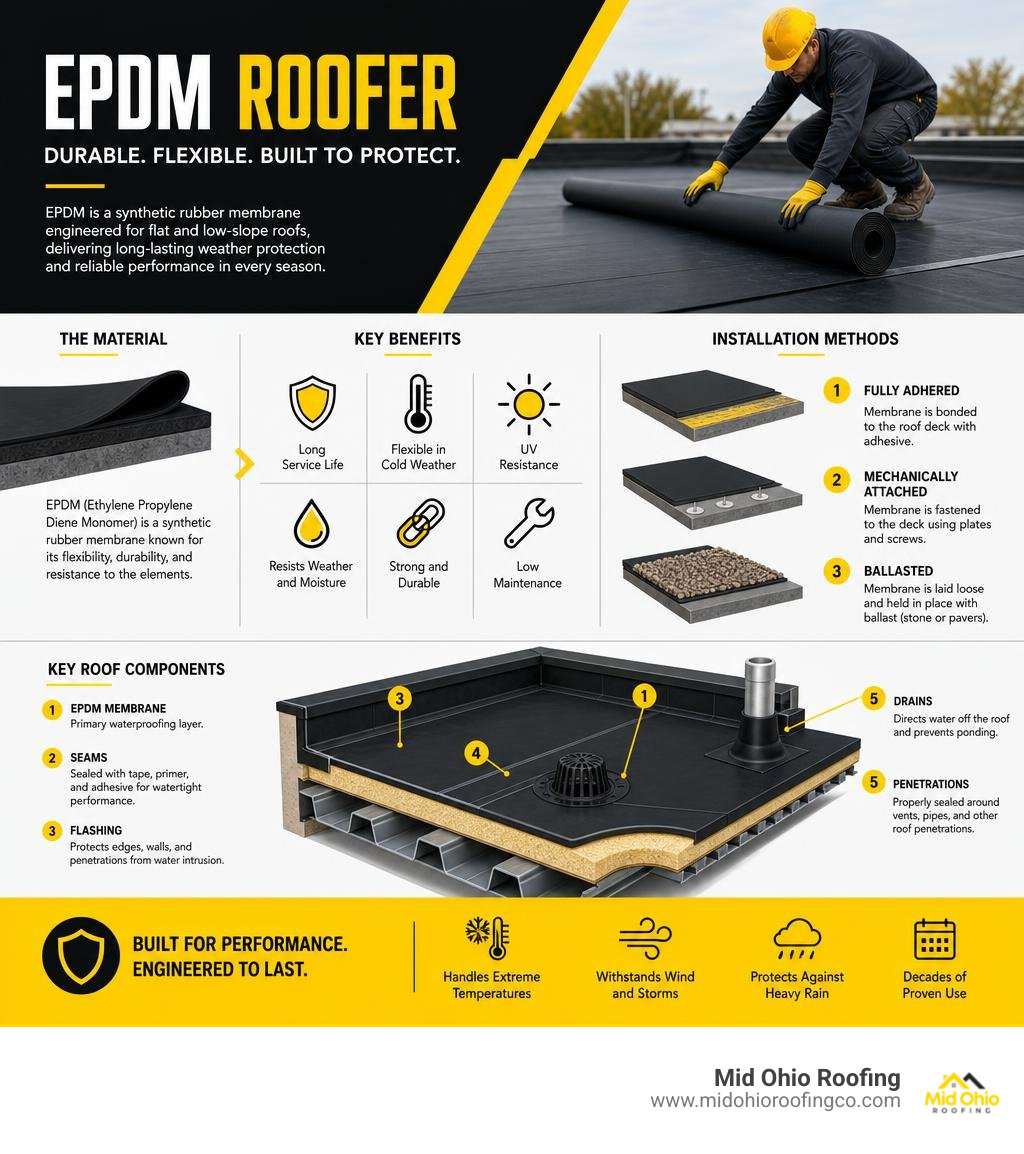
An EPDM roofer installs and repairs durable synthetic-rubber membranes for low-slope and flat roofs. EPDM is a strong option for Ohio homes and commercial buildings because it stays flexible through major temperature swings, resists UV exposure, and can provide decades of weather protection when its seams, drains, edges, and penetrations are detailed correctly.
For dependable Ohio roofing services, the key is choosing the full roof system, not simply the membrane. EPDM sheets come in wide rolls that reduce the number of seams, but every remaining seam and roof detail must be sealed with compatible tape, primers, flashing, and adhesives.
| Quick EPDM roofer answer | What it means |
|---|---|
| Best use | Flat and low-slope residential or commercial roofs |
| Material | EPDM, a flexible synthetic rubber membrane |
| Main strengths | Long service life, flexibility, UV resistance, and strong cold-weather performance |
| Common installation methods | Fully adhered, mechanically attached, or ballasted |
| Key decision | Compare EPDM with TPO and PVC based on climate, roof traffic, energy goals, drainage, and budget |
Black EPDM has a field history of more than 50 years, while white EPDM has been used for more than 30 years. The material can tolerate temperatures from about -49 F to 176 F, an important advantage for roofs exposed to Ohio snow, ice, summer heat, wind, and storm-driven rain.
I am Albert Wengerd, owner of Mid Ohio Roofing, with experience in rubber roofing, flat-roof work, repairs, replacements, and commercial systems across central Ohio; as an EPDM roofer, I focus on practical systems that stand up to changing weather. This guide explains how EPDM works, where it excels, and how it compares with other common flat-roof options.
What Is EPDM Roofing and How Is It Manufactured?
EPDM stands for ethylene propylene diene terpolymer, a synthetic rubber roofing membrane synthesized from primary oil and natural gas polymers. During manufacturing, manufacturers combine these petroleum-derived compounds with carbon black or titanium dioxide to formulate a resilient single-ply membrane engineered specifically for low-slope roofing structures.
The manufacturing process converts liquid chemical compounds into solid sheet rubber through continuous calendering or modern extrusion techniques. Extruded EPDM manufacturing produces cleaner sheets with a highly uniform surface finish, which minimizes job site preparation and enhances bonding performance when adhesives are applied.
Standard EPDM membranes are produced in three primary thicknesses:
- 45 mil (1.14 mm): Used in light-duty commercial and residential flat roof applications.
- 60 mil (1.52 mm): The industry standard for heavy-duty commercial installations, providing balanced durability, tear resistance, and ease of installation.
- 90 mil (2.28 mm): An ultra-thick membrane engineered for extreme weather exposure, high foot traffic, and long-term durability.
Manufacturers produce EPDM sheets in roll widths ranging from 7.5 feet up to 50 feet and lengths reaching 50 to 100 feet. Utilizing wide 50-foot sheets allows an experienced EPDM roofer to cover broad expanses of a flat roof with a single sheet, eliminating up to 90% of field seams compared to traditional multi-ply built-up systems. For technical installation standards and physical property limits, contractors follow comprehensive manufacturer documentation like the RubberGard EPDM Technical Manual.
Reinforced vs. Non-Reinforced EPDM Membrane Options
Non-reinforced EPDM consists of solid synthetic rubber throughout its entire cross-section, delivering an extraordinary 465% elongation capacity. This extreme elasticity enables the unreinforced rubber to expand and contract across extreme thermal cycles without tearing or splitting.
Reinforced EPDM embeds a high-strength, 1,000+ denier polyester woven scrim between two layers of synthetic rubber during manufacturing. While the internal fabric grid reduces total elongation, it dramatically increases puncture resistance, tear strength, and wind uplift resistance, making it the preferred choice for mechanically attached assemblies.
In addition to scrim reinforcement, fleece-backed single-ply membranes feature a polyester fleece layer laminated to the underside. Fleece backing cushions the membrane, increases puncture resistance on high-traffic roofs, and allows full adhesion using polyurethane deck adhesives over rough substrates or existing roof assemblies.
EPDM Accessories and Flashing Components
A watertight EPDM system requires a complete ecosystem of engineered accessories to protect vulnerable roof transitions. An experienced EPDM roofer relies on specialized components rather than field-fabricated substitutes:
- Butyl Seam Tape: Double-sided pressure-sensitive tape engineered specifically for splicing field sheet overlaps.
- Low-VOC Primers: Chemical cleansers and surface preps that strip surface oxidation and activate the rubber surface before tape application.
- Pre-Molded Pipe Boots: Flexible, stepped EPDM boots designed to clamp tightly around cylindrical pipes ranging from 1 to 6 inches in diameter.
- Uncured Flashing Tape: Malleable, non-vulcanized rubber tape that stretches easily to form custom seals around complex inside and outside corners, skylight curbs, and pitch pockets.
- Pourable Sealer Pockets: Rigid framing boxes filled with two-part polyurethane sealers to encapsulate irregular penetration clusters.
- Termination Bars and Water Cut-Off Mastic: Extruded aluminum bars and heavy-bodied compression mastics designed to create continuous watertight seals along masonry parapet walls.
Quality components engineered to work together prevent premature system failure, which is why we utilize high-grade system components described in technical references like FIX-R EPDM Systems.
Core Attachment Methods Used by a Professional EPDM Roofer
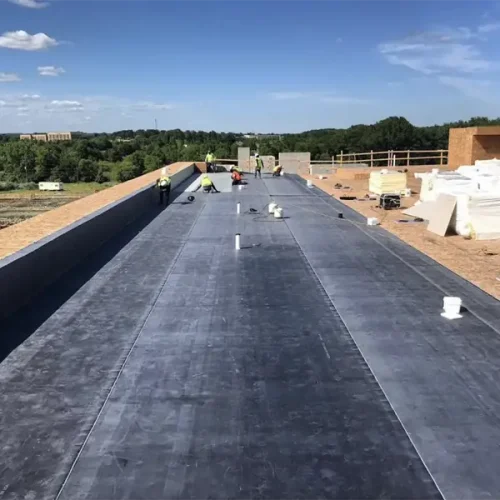
An EPDM roofer utilizes three primary attachment methods to secure synthetic rubber membranes to low-slope building structures: fully adhered, mechanically attached, and ballasted installation.

- Fully Adhered Systems: The membrane is glued directly to the substrate using solvent-based, water-based, or sprayable bonding adhesives. This method offers the highest resistance to wind uplift, creates a smooth exterior profile, and is suitable for roofs of any slope or structural load capability.
- Mechanically Attached Systems: The membrane sheets are laid over cover boards and secured to the structural deck using heavy-duty mechanical fasteners and stress plates placed inside the seam overlaps. Mechanically attached roofs install quickly on large commercial structures, making them cost-effective for steel and wood deck construction.
- Ballasted Assemblies: EPDM sheets are laid loosely over insulation and secured at perimeters, then held down across the field of the roof by a minimum load of 10 to 12 pounds of smooth river stone ballast or concrete pavers per square foot. Ballasted systems install rapidly and provide superior fire protection and thermal mass, provided the building structure can support the heavy dead load.
- Vent-Secured Systems: Advanced specialized systems use dynamic equalizer vents that harness natural wind flow across the roof deck to generate a vacuum suction force, pulling the non-adhered membrane tightly against the substrate during severe windstorms.
Contractors verify structural load capacities and attachment rules outlined in technical documentation such as EPDM System Specifications.
Substrate and Insulation Compatibility Guidelines
EPDM membranes require rigid, smooth, and dry substrates for proper attachment. Approved thermal insulation and cover board substrates include polyisocyanurate (polyiso) insulation boards, high-density glass-mat gypsum boards, cementitious cover boards, and high-density wood fiberboards. Polyisocyanurate provides an industry-leading thermal value of approximately R-5.7 to R-6.0 per inch, reducing heating and cooling costs for property owners.
Solvent-based EPDM bonding adhesives contain chemical carriers that immediately melt and dissolve expanded polystyrene (EPS) and extruded polystyrene (XPS) rigid foam board insulation.
When installing over polystyrene insulation, an EPDM roofer must install an approved separator cover board, such as a 0.5-inch high-density wood fiberboard or gypsum glass-mat board, prior to adhesive application. Structural concrete decks, exterior-grade OSB, and tongue-and-groove plywood decks are direct-apply substrates, provided all panel joints are tight and offset. For complete details on building assembly layering, review our comprehensive guide on Flat Roof Systems.
Safety Considerations for an EPDM Roofer
Professional installation prioritizes crew safety and structural protection by eliminating open flames during application. EPDM systems utilize cold-applied adhesives, self-adhesive tapes, and mechanical fasteners, making them 100% flame-free and safer than asphalt torch-down roofing assemblies.
Key safety protocols observed by professional installation crews include:
- Solvent Flash-Off Management: Solvent-based bonding adhesives release flammable vapors during drying. Crews ensure proper ventilation and strictly prohibit open flames or sparks on the job site.
- Cold Weather Application Thresholds: Below 40°F (4°C), solvent evaporation slows dramatically, and ambient moisture can condense on freshly applied adhesive surfaces, creating a slick layer that prevents bonding. Adhesives and primers must be stored between 60°F and 80°F prior to application in cold weather.
- Fall Protection and Perimeter Safety: Flat roof perimeters require warning lines, guardrail systems, or personal fall arrest harnesses attached to anchored lifelines.
- Substrate Surface Drying: Installing adhesives over damp substrates traps water vapor beneath the impermeable rubber membrane, resulting in gas expansion bubbles and widespread membrane blistering when solar heat hits the roof.
Detailed material safety practices are outlined in step-by-step documentation like the EPDM Installation Manual.
EPDM vs TPO and PVC: Comprehensive Comparison
Selecting the ideal single-ply membrane requires evaluating material properties, total installed cost, thermal performance, and chemical exposure conditions.
| Roofing Parameter | EPDM (Ethylene Propylene Diene Monomer) | TPO (Thermoplastic Polyolefin) | PVC (Polyvinyl Chloride) |
|---|---|---|---|
| Material Category | Vulcanized Synthetic Rubber | Thermoplastic Polyolefin Blend | Reinforced Polyvinyl Chloride |
| Primary Seam Joining Method | Butyl Seam Tape & Primer | Hot-Air Heat Welded | Hot-Air Heat Welded |
| Service Life Expectancy | Up to 50 Years | 15 to 25 Years | 20 to 30 Years |
| Thermal Elongation & Flexibility | Exceptional (Up to 465%) | Moderate | Moderate |
| Cold Weather Flexibility | Maintains flexibility down to -49°F (-45°C) | Can become brittle in sub-zero cold | Retains moderate flexibility |
| Chemical & Oil Resistance | Poor against animal fats & petroleum | Moderate | Excellent against oils, fats, & grease |
| Hail & Impact Absorption | Outstanding (Unreinforced rubber cushions impacts) | Moderate (Puncture risk on aged scrim) | High (Reinforced flexibility) |
| Solar Reflectance Options | Black (Standard) / White (EcoWhite) | Highly Reflective White | Highly Reflective White |
While TPO and PVC rely on heat-welded seams, EPDM utilizes chemical cross-linking with factory-applied seam tape, eliminating the risk of cold-welded seam voids. Property managers exploring system upgrades can review our specialized options for Commercial Roofing installations.
EPDM Durability and Weather Performance Strengths
EPDM synthetic rubber exhibits unmatched resilience against environmental degradation. Its atomic structure resists breaking down when exposed to intense ultraviolet radiation, ground-level ozone, and extreme temperature fluctuations ranging from -45°C (-49°F) up to +80°C (176°F).
In cold climates like Central Ohio, black EPDM absorbs solar heat during winter months, melting frost, dew, and heavy snow loads faster than light-colored reflective membranes. Fast snow melt reduces structural dead load and prevents destructive ice dam accumulation along roof drains and scuppers. Furthermore, the inherent 465% elongation capacity allows unreinforced 60 mil EPDM to absorb severe hail strikes up to 2 inches in diameter without fracturing the underlying waterproofing barrier.
Environmental Benefits and Green Roof Compatibility
EPDM synthetic rubber is one of the most environmentally sustainable single-ply roofing choices available today:
- 100% Recyclability: At the end of its useful service life, post-consumer EPDM membrane can be removed, ground down, and recycled into new roofing accessories, walkway pads, and athletic surfacing.
- Cold-Applied Eco-Safety: Cold-applied adhesives eliminate toxic fumes, dangerous smoke, and energy-intensive kettle heating during application.
- Green Roof & Rooftop Garden Integration: EPDM membranes carry root-barrier certifications and BBA approvals making them ideal waterproofing underlayments for extensive and intensive vegetative green roofs.
- Condensation Reduction: When properly installed over a continuous vapor retarder, black EPDM keeps roof assemblies above dew point temperatures during cold weather, reducing interior structural condensation.
To accurately calculate materials for eco-friendly systems, estimators reference guides like the Materials Estimator Guide.
Seaming, Flashing Penetrations, and Maintenance Best Practices
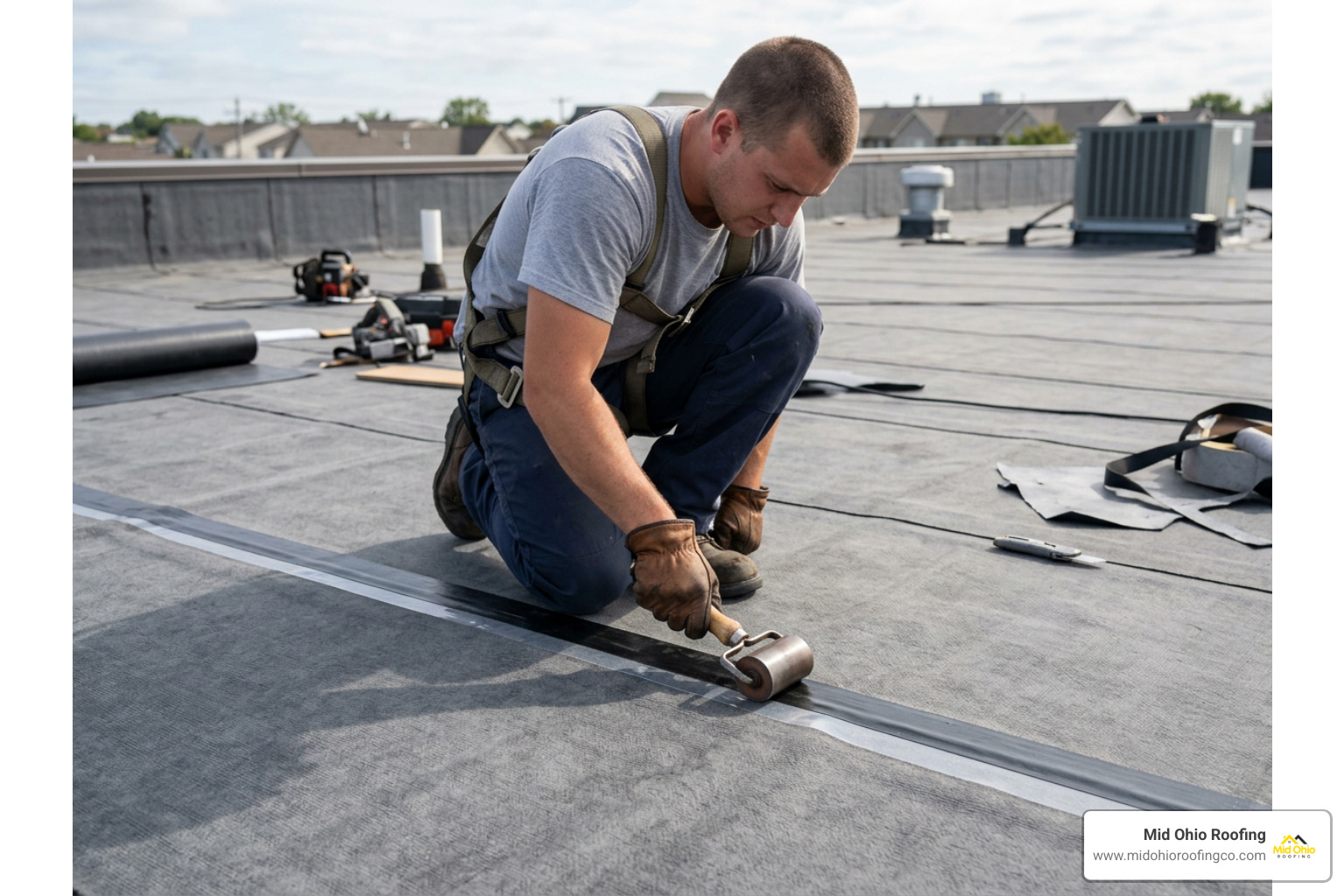
Field seams represent the single most critical element of an EPDM roof installation. Modern installations rely on factory-applied seam tape (QAT – Quick Applied Tape) technology, which bonds sheets together with uniform adhesive thickness and eliminates human error during liquid adhesive spreading.
To join two sheets of EPDM membrane:
- Overlap adjacent sheets by a minimum of 3 to 4 inches.
- Clean weathered or dusty rubber using specialized solvent cleaners.
- Apply a low-VOC seam primer using an abrasive scrub pad to chemically cleanse and etch the surface.
- Allow the primer to dry until tacky to the touch without transferring liquid to fingertips.
- Unroll double-sided butyl seam tape along the bottom sheet, remove the protective release liner, and lay the top sheet down smoothly.
- Roll the entire seam length using a heavy silicone or steel hand roller, applying firm perpendicular pressure to weld the tape to both rubber sheets.
Unprimed membrane application will lead to seam failure. For official application instructions, refer to the manufacturer EPDM Installation Guide.
How an EPDM Roofer Flashes Pipes, Curbs, and Walls
Roof penetrations require specialized detail work to maintain continuous waterproofing integrity:
- Pipe Penetrations: Round mechanical pipes are flashed using pre-molded, stepped EPDM pipe boots. The boot is sliding over the pipe, bedded in water cut-off mastic at the base, primed, taped to the field sheet, and clamped firmly at the top edge using a stainless steel hose clamp.
- Curbs and Skylights: Square equipment curbs are wrapped with field membrane extending up vertical walls at least 12 inches. Uncured EPDM flashing tape is stretched into place over inside and outside corners to eliminate relief cuts and seam overlaps.
- Corner Stress-Relief Cuts: Whenever membrane cuts are made at 90-degree corner transitions, an EPDM roofer punches or cuts a small round hole at the end of the slit to relieve structural stress and prevent tear propagation under tension.
- Parapet Wall Terminations: Vertical membrane terminations are sealed by applying a continuous bead of water cut-off mastic against the masonry wall, compressing the rubber with an aluminum termination bar secured with mechanical fasteners spaced every 6 to 12 inches, and topping the bar with single-ply lap sealant.
Proper detailing ensures long-term leak protection, as outlined in our primary section on professional Roof Installation.
Preventative Maintenance and Leak Repair Procedures
While EPDM requires minimal upkeep, establishing a semi-annual preventative inspection routine in spring and fall extends system life up to 50 years. Inspections focus on clearing roof drains, checking perimeter coping metal, inspecting pipe boot clamping bands, and verifying seam integrity around HVAC units.
If an accidental puncture occurs due to dropped tools or severe storm debris:
- Clean the damaged area extending at least 6 inches beyond the puncture using a weathered membrane cleaner.
- Scrub low-VOC primer over the cleaned rubber and allow it to dry until tacky.
- Apply a self-adhesive peel-and-stick EPDM repair patch, rounding all four corners with scissors to prevent edge peeling.
- Roll the repair patch thoroughly with a steel hand roller from the center outward.
- Apply a bead of lap sealant around the entire perimeter of the patch to protect the cut tape edge.
Property owners can master quick DIY fixes by reviewing our step-by-step guide on Blog: No More Leaks with This Easy EPDM Roof Patch Repair Trick. For complex structural damage, contact our professional crew for emergency Roof Repairs.
Frequently Asked Questions About EPDM Roofing
How long does an EPDM roof last compared to other flat roof options?
An EPDM roof system lasts up to 50 years when properly installed and maintained, outlasting standard TPO membranes (15 to 25 years) and asphalt built-up roofs (20 years). Leading manufacturers offer 20-year to 30-year commercial material warranties, and systems backed by British Board of Agrément (BBA) certificates hold documented service lives exceeding 35 years. When your building requires a full tear-off, explore our options for complete Roof Replacement.
What is the difference between black EPDM and white EPDM?
Black EPDM contains carbon black, which absorbs solar heat and provides superior performance in cold northern climates like Ohio by reducing heating costs and melting rooftop snow. White EPDM incorporates titanium dioxide to create a reflective surface with an initial solar reflectance index (SRI) up to 0.80, making it ideal for southern climates where lowering air conditioning cooling loads is the primary energy goal.
How do you repair a puncture or leak in an EPDM membrane?
Repairing an EPDM membrane requires cleaning the damaged area with a specialized solvent cleaner, applying a low-VOC primer, pressing a self-adhesive cured EPDM patch over the puncture, rolling it firmly with a steel roller, and sealing the patch edges with lap sealant. Never apply asphalt roof cements or oil-based mastics, as petroleum products chemically react with and melt synthetic rubber membranes.
Conclusion
Selecting an EPDM rubber roof system provides long-term weather protection, extreme flexibility across freeze-thaw cycles, superior hail resistance, and up to a 50-year service life. Whether protecting a residential garage or a large commercial facility, success depends on precision craftsmanship, proper substrate preparation, and expert seam execution.
At Mid Ohio Roofing, we bring local expertise, transparent pricing, and factory-trained craftsmanship to every flat roofing project across Mount Perry OH, Columbus OH, Newark OH, Athens OH, Zanesville OH, and Central Ohio. If you are evaluating flat roof replacement options, check out our guide on Blog: Top-Tier EPDM Roof Replacement Columbus Solutions or read how property owners solve leaks with Blog: Don’t Let Flat Roofs Leak with Athens EPDM Replacement.
Ready to protect your property with a long-lasting synthetic rubber roof? Schedule your flat roof inspection today by visiting our EPDM Roofing service page or getting in touch through our Contact Page!